
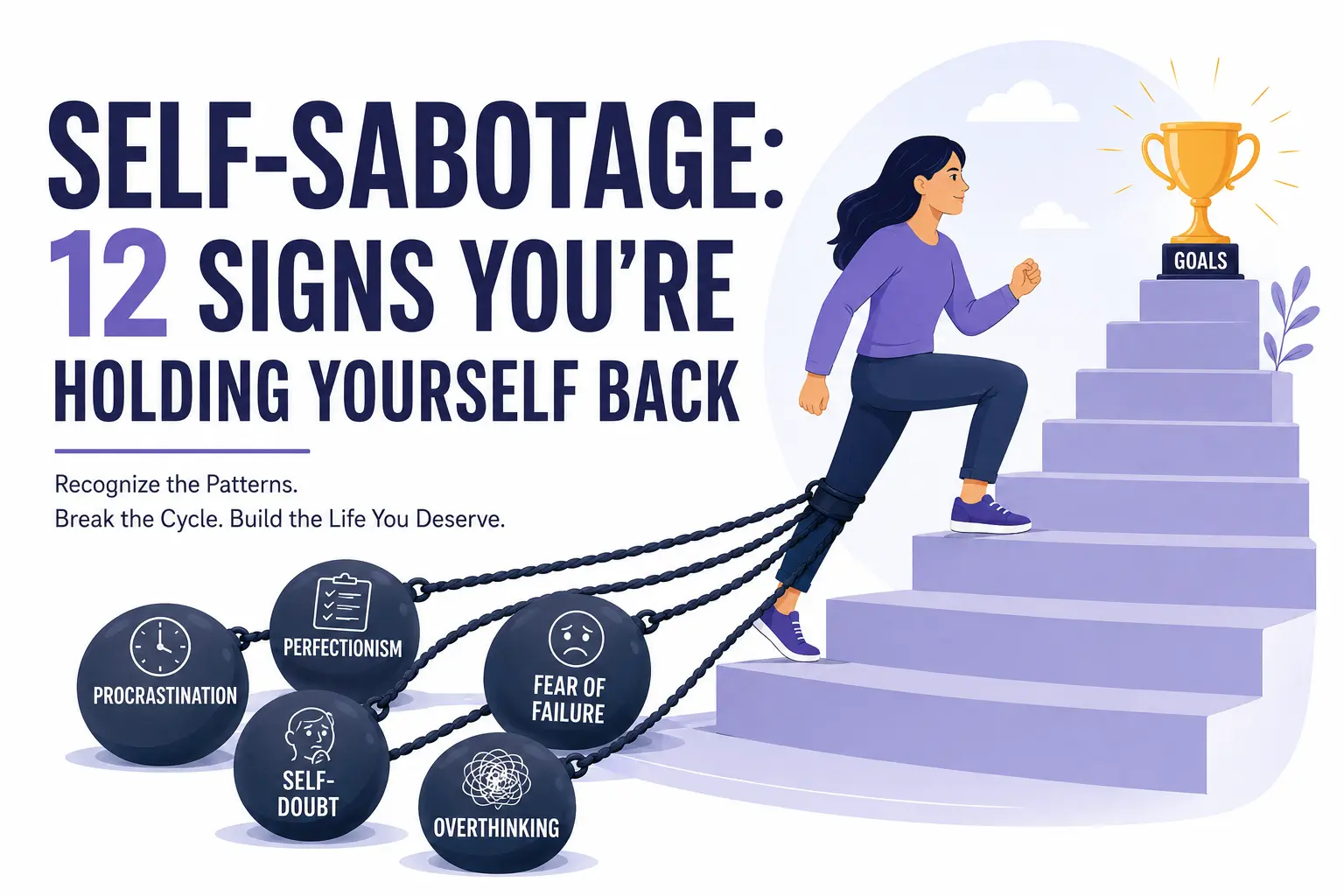
Self-Sabotage: 12 Signs You’re Holding Yourself Back
Your friend made the same resolution as you. He is improving every day. You’ve arrived back where you began. It is not laziness. It is self-sabotage; it is happening beneath the level of conscious thought. This is how it manifests, the reasons for it, and how to prevent it.
What Is Self-Sabotage? (It Is Not the Same as Laziness)
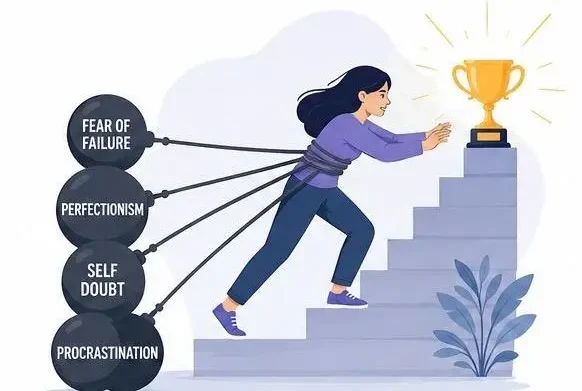
Self-sabotage is when you cause your own harm. Self-sabotage is taking away your goals, your efforts, and your motivation. You don’t do all this because you don’t care about yourself. You don’t even realise it yourself, and some part of your mind keeps nagging you about all these things, and you don’t feel like doing any of them.
The Exam Scenario:
You have an exam this morning. You have the whole day and the whole night to prepare for the exam. But you slept the whole day and spent the whole night scrolling through your mobile. You had the time, you had the opportunity, and everything was clear. You could prepare for your exam. You also knew that you had an exam this morning, but you didn’t prepare. It’s not that you weren’t worried, but you thought a lot that you should prepare, but you used your mobile the whole night despite knowing this. You caused yourself harm, and you were unaware of it.
We attribute all of this to our laziness. However, self-sabotage occurs when a person tries when he feels like doing anything, and laziness occurs when a person doesn’t feel like doing anything. However, self-sabotage occurs when something is lacking in all of this. Self-sabotage is not a negative behaviour. The person is simply experiencing a strong mental reaction without realising it.
12 Signs You Are Self-Sabotaging
Self-sabotage doesn’t always seem as glamorous as it sounds. It’s usually manifested as procrastination, perfectionism, self-criticism and/or busyness. These are the 12 patterns most often found in all the research that exists about it.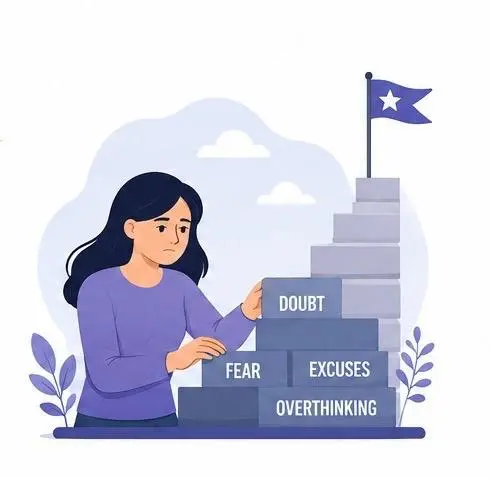
Comparing yourself to others and losing courage:
Whenever you see someone on social media, you always think low of yourself and lose courage in saying that you can never be like them. The comparison kills your motivation before you have even begun.
Not always keeping yourself ready for important work:
Be it any important task, project deadline, last-minute interview, or delaying a meeting, delaying all these important tasks and not preparing for them is a kind of self-harm.
Emotionally numb yourself:
Every time you have a problem, you go to numb yourself out and avoid them, such as using your mobile, watching Netflix, etc. It feels good at the moment, but the issue stays the same – it is not resolved.
Overthinking until the opportunity passes:
Overthinking too much before doing every work, the work and opportunity get lost.
Making excuses for everything:
The first thing you start doing is making excuses like the task isn’t perfect yet, and in the pursuit of perfection, you end up losing it.
Thinking and speaking negatively about oneself:
I can’t do this by constantly talking negatively about myself. I can’t succeed at anything. It just destroys your confidence.
Quitting after coming very close to success:
When you start any work, complete every difficult phase, and when you are finally very close to success, you quit at the winning point, and this is the most painful sign of self-sabotage.
Planning your goals and then breaking them yourself:
In the beginning, there is excitement in setting your goal, you plan everything, but slowly you convince yourself that there is still a lot of time, I am busy, I am not in the mood, saying all this, and then moving away from your goal.
Focusing on every non-essential task while choosing your important work:
You avoid your important work but waste energy on every work that is not necessary at that time, like you have an interview in the morning, but instead of preparing for it, you start deep cleaning your room and sleep late at night.
Do not do anything to avoid criticism from people:
You don’t do anything new to avoid people’s thinking and their criticismLetting your past mistakes define you:
The one thing you have done wrong in the past makes you wrong the rest of your life, and you can never forgive yourself because you believe that you are never going to do anything right.
Making self-care your last priority:
Not eating on time, not getting proper rest and sleep, not doing physical exercise – all these things you don’t take on, and saying you don’t have time for these things. This keeps your energy low, and you can’t get any work done properly.
What Does Psychology Say About Self-Sabotage?
Understanding why self-sabotage happens is more useful than blaming yourself for the fact that it does. These are the most well-documented psychological drivers.
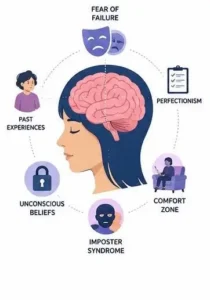
Unconscious beliefs from the past:
You are self-sabotaging due to a past incident that continues to affect your behaviour now, and you don’t even know it. It is as if you were told as a child that money ruins people and makes them greedy. Now that you are older, you do not want to work, but you secretly think money will kill you.Don’t step out of your comfort zone:
It’s a well-known fact that one can’t move forward unless they venture out of their comfort zone. Remaining in your comfort zone equals temporary peace but not success. However, your life’s growth comes only by overcoming comfort. Therefore, whenever there’s any hard or tiring work, you avoid it.
Understanding Your Own Self-Worth Low
Since childhood, you have heard about yourself that you can never succeed, you will never be enough for anyone, such words get deeply embedded in your mind, and even after becoming an adult, you consider your self-worth low in front of others due to these things, and whenever any opportunity comes in your life, you do not avail it, thinking the same.
Fear of success
Reading this point, you felt strange that a person had the fear of becoming successful. But in self-sabotage, a person fears that if they become successful, people will have high expectations of them, and they may not be able to fulfil them. They also fear that if they succeed, they may face a lot of pressure and they will be unable to handle it. Therefore, self-sabotage often ruins a person’s success at the very peak.Fear of failure
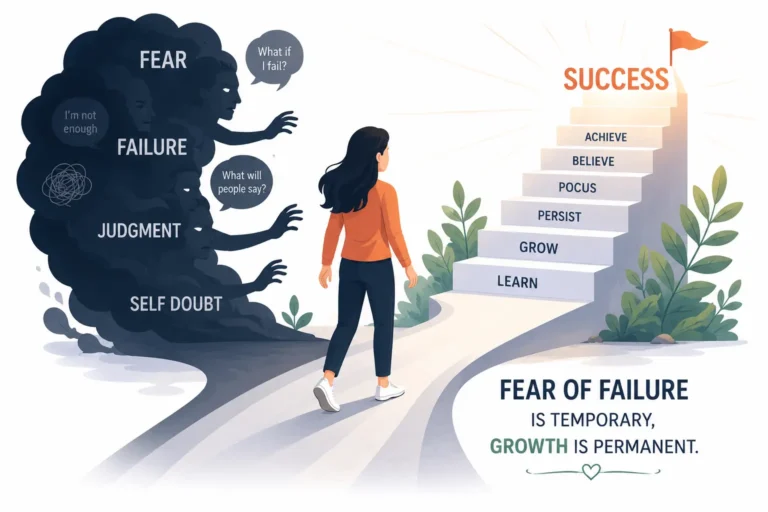
While a person has a fear of success, it is also normal to have a fear of failure due to self-sabotage. In self-sabotage, a person often makes excuses before taking any step due to fear of failure. In psychology, this is called hand-capping, when a person is unable to grow due to fear of people’s judgement and puts himself back by making excuses every time. He is afraid that if he makes a mistake or fails in any work, his respect in front of people will be lost, and he will be embarrassed. Therefore, due to this fear, he stops himself from the path of success.
Addiction to instant rewards
You don’t find joy and happiness in long-term hard work, so you self-sabotage because of your addiction to rewards for short-term and temporary work.
Misidentification of self
If you think in your heart you’re worthless, that you will never be successful, that you will never grow, no matter how hard you try, that you will never be able to grow, that’s the wrong attitude to have. Just having a negative image in your head that you are not successful is a negative attitude; you will never be successful.Avoiding emotional Feelings
When you are upset or worried about something, or you are hurt because of something, you tend to avoid those feelings instead of analysing them or understanding them. You are undermining yourself. When you can’t even imagine how bad you feel, you can’t even find a solution. You sleep, or you do not deal with the problem for a while, but you can not come up with a solution.
Always seeking approval from others
You don’t have the authority for your own wishes or decisions, but rather want others to think about it. This means you don’t make your own requests and constantly seek others’ decisions and approval, which hurts you.
A Real Story: Watching Self-Sabotage Up Close
There was a friend of mine who loved to draw and art. She was very talented in art. One day, I noticed in a post that there was a competition for artists where she could demonstrate her power to the whole world. I told her to go for that competition. She worked on her art all night long, drawing every day.
She wasn’t there the day of the competition. She said she didn’t go because she was afraid people would laugh at her art, even though there were other people there who were better than her. As I said, she remembered drawing a picture of her teacher, and everyone made fun of her at school. She still feels that when she displays this art to people, they will laugh at her again.
The results of the competition were announced a few days later. She gave me a look and said to me, “Look, I told you people have more talent than me. But what I saw was that she made all her preparations by herself, but the fear of rejection did not reach her on that day. And she considered it her protection. She would’ve broken her old system, and her fear of failure would have been over that day if she had gone to the competition.
Summary:

We are usually the ones when things go wrong in our lives, not others. We need to let go of mistakes and change our ways. Until we do this, we won't be able to improve as individuals. The key is to recognise our self- behaviour and make a change. We must take action to stop sabotaging ourselves and break this habit. This is crucial for our growth. To truly overcome self-sabotage
Related on Savvy Psyche
How Self-sabotage Slowly Affects Every Part of Your Life:
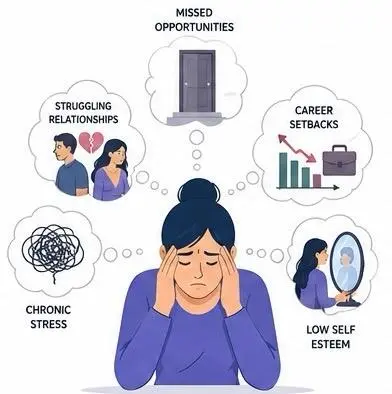
Self-sabotage may manifest as a habit that gets in the way of your personal progress. But in reality, it creeps into every aspect of your life. And the most shocking thing is you don’t know it.
- Your personal growth stops: Self-sabotage stunts your own personal growth. You may be afraid to meet people, try new things, or take risks, which negatively affects your growth.
- Financial instability: People who self-sabotage often avoids saving. They remain stuck in old investments or face financial crises without trying anything new.
- Mental condition worsens: Self-sabotage can cause you to constantly see yourself as a failure, irresponsible, careless, or think negatively about yourself. You can cause your own mental health to suffer. You may experience anxiety, stress, or depression.
- Distance in relationships: Self-sabotage can cause you to avoid important relationships and react negatively to every little thing, creating misunderstanding and distance from your family and partner.
- Interruption in career: When you focus on short-term and temporary rewards instead of long-term hard work, you miss out on authentic promotions and opportunities, which stunts your career growth.
The Hidden Cycle: How Protection Becomes a Trap
The most crucial thing to know about self-sabotage is that it began with great reason.
At some point in your past, You must have experienced this while being a child, when you said something in public or did something that made you feel ashamed. At that time, you absolved yourself of this and came out in public, refrained from saying those useless things and doing those stupid things.
Now, this cycle did not end there, so you fixed that embarrassing experience of yours in your mind till it was over and kept thinking that whenever I would say it in public, people would laugh at me and make fun of me. Although you have matured now, your cycle repeats itself. Whenever you are in public, you get embarrassed. Therefore, you never took this risk, and your growth was hampered.
Understand that at that time it was right for you to stop, you took your lesson by mistake, that was your protection, but this thing is becoming a trap for you in the mode of self-sabotage. You are repeating that cycle, you are not changing your perspective, you are harming yourself.
Now you will realise from this point of view that the problem is not in you, but in the system which you have made your own protection; in fact, it has now become a trap for you.
What Studies Say About Self-Sabotage?
Berglas & Jones (1978)
Self-handicapping theory: creating obstacles on purpose
According to the 1978 self-handicapping theory by Berglas and Jones, people create obstacles in their own lives, and if something goes wrong, they blame that obstacle. Berglas and Jones argued that people create so many barriers in their lives that if they fail, they can say that their failure was due to this obstacle. And they don’t want to blame themselves.
Clance & Imes (1978)
Imposter syndrome: success triggers more anxiety, not relief
Flett & Hewitt (2002)
Perfectionism and procrastination: the paralysis of impossible standards
In 2002, two studies found a strong relationship between perfectionism and procrastination behaviors often considered opposite.Two studies in 2002 came to the same conclusion as Flett and Hewitt, that the relationship between perfectionism and procrastination is strong, even though some people think of them as opposites. Their study found perfectionists to be much more likely to procrastinate when facing a task because it seems they feel like they cannot get the work to match up to what they think it should look like. Not starting is the perfecter’s way of keeping living in the fantasy of what they might accomplish: not starting means never discovering that the outcome would have been imperfect.
8 Proven Steps to Stop Self-Sabotage
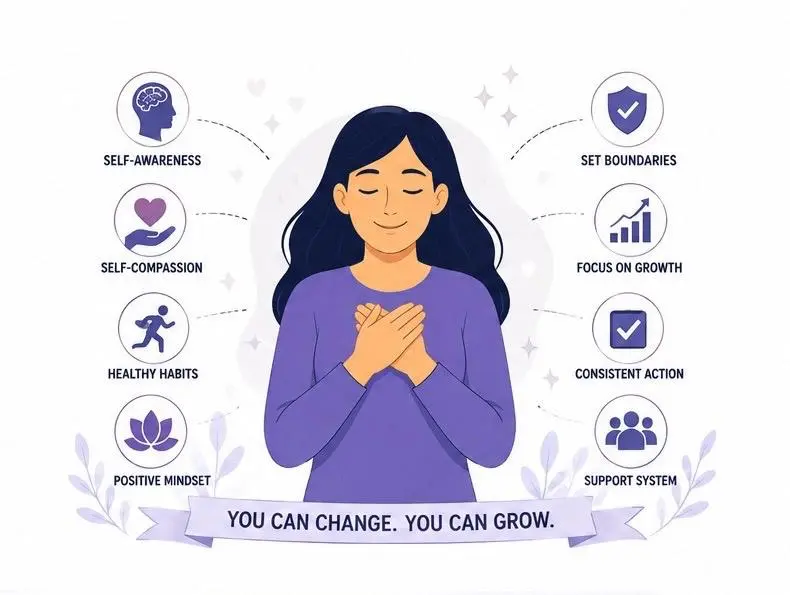
Self-sabotage isn’t something you can erase from your life in a day. These are not tricks that will make you see instant improvements right away, but if you use them correctly with full dedication and patience, it will be much easier to get rid of self-sabotage.
Judge your pattern, not yourself
To eliminate self-sabotage, the first thing you do is prove wrong in your mind the pattern you think is your protection. Name that pattern, that it’s not your protection, but a trap. Observe how you eventually come close to success and end up weak, only to be stopped by your own self-created cycle. Judging your pattern will make it much easier to eliminate self-sabotage.Challenge your old beliefs
The beliefs you believe about yourself, such as ” I can never succeed, or no one can love me. You’ve cultivated these kinds of ideas in your head. Put them on paper and assess the degree of truth they contain. Your self-sabotage eventually wanes and vanishes as you question your beliefs in light of this fact.
Pause and ask what you are actually afraid of
Take a time to consider, What made me stop, and what are you afraid of? when you find yourself delaying at work. Take ten seconds to consider this question. Your self-sabotage will be gradually eliminated by this break.
Use the CBT technique for negative thoughts
Whenever you get any negative thoughts related to yourself, at that time use the CBT technique and find it easy to make your thinking positive. For example, if you feel that you will fail in your paper tomorrow, then you will change that thought and think based on facts. Since you have not taken the exam till now, you cannot fail, and you have a lot of time for preparation, and you will challenge yourself to prepare well, prepare for the exam, and pass.
Break large goals into daily minimum actions
When you decide to achieve your big goal, think that there are high chances that you will be scared of that goal and will be rejected. Therefore, divide any big goal of yours and work on it with daily consistency. If you want to write a book, you will be afraid to write the whole book, and your courage will be weak. Therefore, make a mindset to write 2 pages daily, which will be easy.
Be your own best friend
Talk to yourself like you would talk to a close friend or a loved one. Have faith in yourself and convince yourself that you can accomplish anything. Be sure of all things. This will provide you with positive reinforcement and keep you from going into self-sabotage.
Try changing your environment
Our surroundings can occasionally set off self-sabotage. Try making some small adjustments to your surroundings and yourself. Spend time in outdoors, spend less time on your phone, and surround yourself with good people. Making such adjustments can lessen your likelihood of self-destruction.
Track attempts, not just outcomes
When the end goal is the result, anything that doesn’t result in the visible thing is considered a failure, which brings back the negative beliefs that are causing the sabotage. How many times did you try to measure your work this day? Have you sent the application? Did you show up? By tracking the action, you remove the evaluation from your self-presentation and build evidence of self as an attempter the first step to becoming a success.
When to Seek Professional Help


For those who experience self-help strategies as being effective, it’s when the pattern is relatively recent or shallow. Self-sabotage that has been deeply entrenched in childhood programming, significant trauma or has been in place for many years could be more powerful than individual effort.
Consider working with a therapist if:
- This situation has been in place for years and it is not being changed.
- The self-sabotaging behavior is linked to a great deal of anxiety, depression, or trauma.
- It is impacting on several aspects of your life at once
- You feel you know the pattern but can’t change it.
Conclusion:
It is difficult to break the cycle of self-sabotage, but your life will get simpler if you recognise this old tendency and work with patience and courage. Every human being sometimes stops and gets sick in their life, which gets in the way of their own success. The only difference is that you should know the problem and solve it. In this article, we will understand self-sabotage in detail and find the solution too. We hope that reading this will be of great help to you.
Reminder:
You are not alone. If you ever feel tired, stop and observe what is tiring you, but never let your courage break. When you yourself realise that there is self-sabotage within you, don’t be afraid, just be courageous. By identifying yourself correctly, you have found the first step to the solution, and you will be able to fix everything else yourself.

Disclaimer:
All information provided to you in Savvy Psyche articles is based on personal experience and proven mental health studies. If you have a serious mental health issue, please seek help from a licensed therapist.
Sources & Further Reading
-
Berglas, S., & Jones, E.E. (1978). Drug choice as a self-handicapping strategy in response to noncontingent success. Journal of Personality and Social Psychology, 36(4), 405–417. View study
-
Clance, P.R., & Imes, S.A. (1978). The imposter phenomenon in high achieving women. Psychotherapy: Theory, Research & Practice, 15(3), 241–247. View study
-
Flett, G.L., & Hewitt, P.L. (2002). Perfectionism: Theory, Research, and Treatment. American Psychological Association. APA overview
-
Neff, K. (2011). Self-Compassion: The Proven Power of Being Kind to Yourself. William Morrow. Self-compassion research overview
-
APA (2023). Cognitive behavioral therapy for anxiety and avoidance
-
Psychology Today: Self-sabotage overview and research

2 Comments