
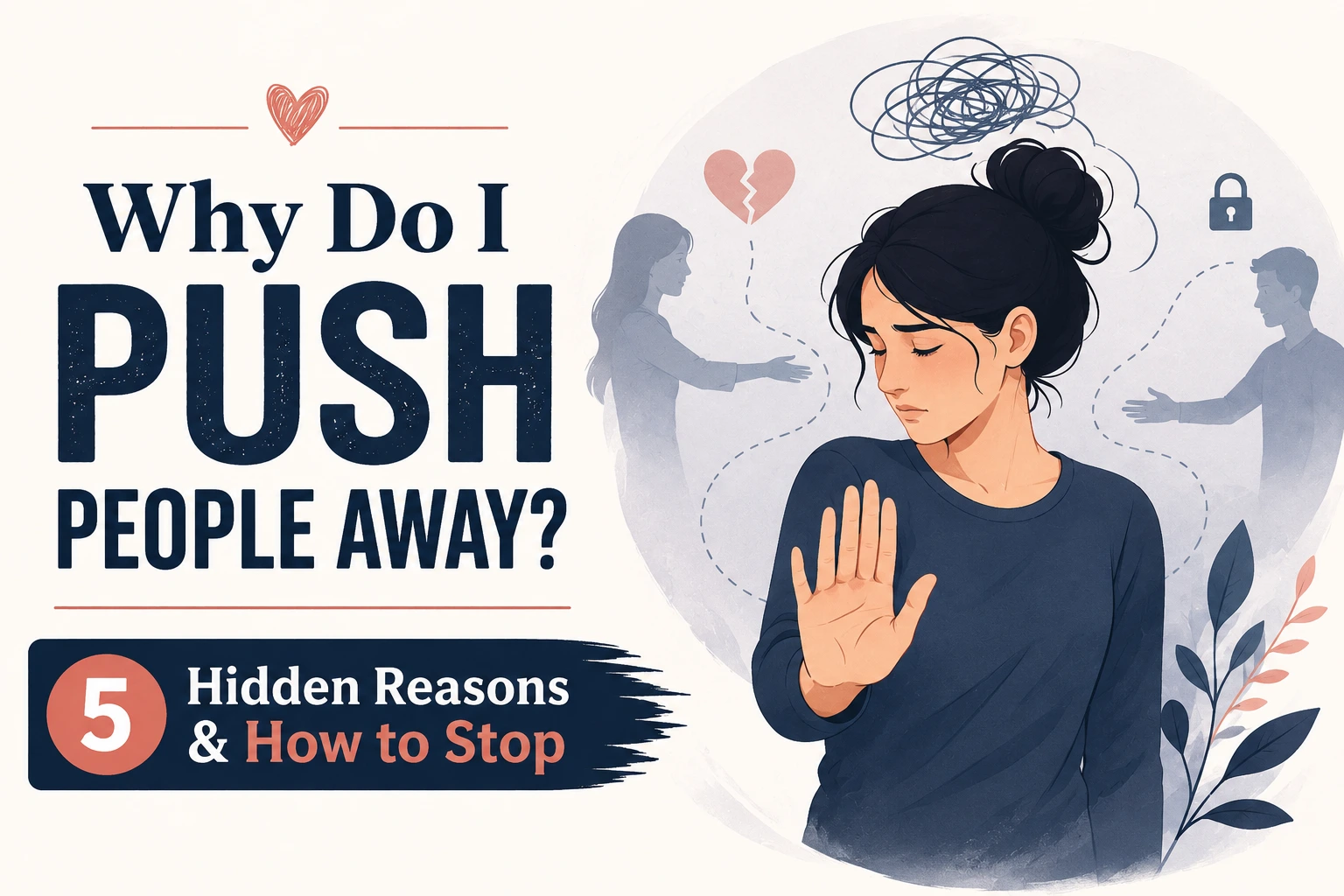
Why Do I Push People Away? 5 Hidden Reasons & How to Stop
Today again I ended my close relationship, and again my loneliness came into my life. Why do I do this? You also agree with this, saying a lot. When you’re having a good close relationship, you’re receiving love, but the very next moment, you push that person away. Pushing people away doesn’t make you heartless. But when you feel a sense of closeness, you perceive this behaviour as dangerous. You think it’s safe to be alone, but becoming close to someone is a threat to you.
Late at night, you see on your mobile those couples who have made their relationship fun, deep, and happy. You cannot do anything like this. Whenever you want such a connection, at that very moment, you push the person in front of you away from yourself. Why?
This is not heartlessness. This is a protection strategy your nervous system learned, probably a long time ago. And the fact that you are asking “why do I push people away?” means you are already ready to understand it, which is the first step toward changing it.
What Pushing People Away Actually Looks Like?

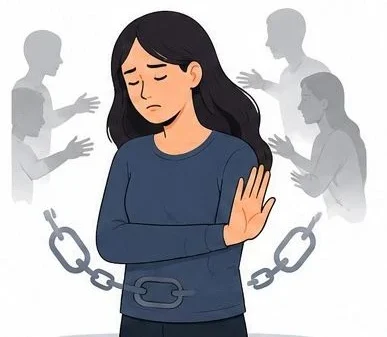
Not being around people doesn’t always mean you are telling them outright that you don’t need them or need to no longer have to be around them. This is very hard to do, but it is very painful to the person talking, resulting in guilt feelings. In reality, distancing yourself from people is like, first of all, you start distancing yourself from them, and then suddenly disappear. They make you feel like you don’t need any close connection, that you’re safe alone.
To recognise what it’s like to push people away, we’ll study some signs:
- Whenever someone comes close to you, you avoid meeting them and cancel your plans to meet them.
- You find fault with that person when someone cares for you.
- The thought that that person will trouble me later makes you distance yourself from that person without any reason.
- You share more of your things with them in the beginning, but later you get scared and create distance.
- Initially, everything is going well, but you suddenly start giving very cold replies and responses without any reason.
- Whenever you get overwhelmed, you distance yourself from that person without any fault of his/hers.
- You become irritable and start interfering in every matter, due to which that person ignores you.
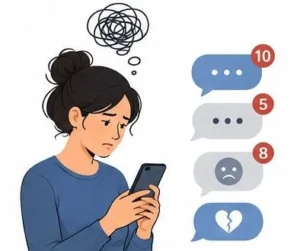
To understand why do I push people away, it’s important to look at the deeper emotional patterns behind this behavior.
A real experience college friendship:
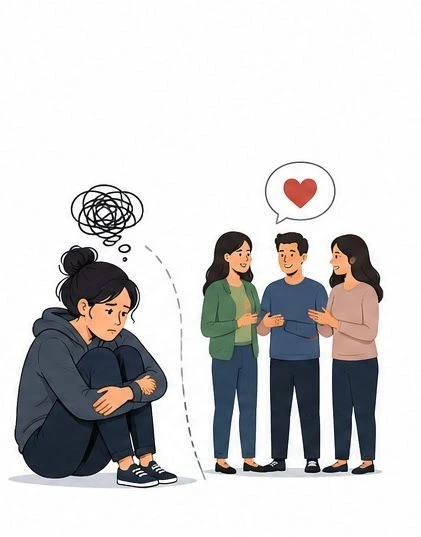
During my internship, someone shared a personal experience with me about friendship that really stayed in my mind.
She told me that when she started college, she was very lonely. After some time, she made a friend, and eventually their group grew to five girls. They had a great time together, but after about a year, she suddenly started feeling uncomfortable as the friendships became closer.
She began ignoring group messages, spending breaks in the library, and avoiding them. Eventually, her friends got upset and ended the friendship. What confused her most was that they had never actually done anything wrong.
Later, she realized that she was afraid of becoming too emotionally dependent on them. She kept thinking, “What if I get too comfortable with them and they leave me someday? It will hurt even more.” So, without realizing it, she started distancing herself to avoid a pain that hadn’t even happened yet.
What I Learned From Her Story
Sometimes we don’t distance ourselves from people because they hurt us. We distance ourselves because we’re afraid of becoming attached and losing them later. Sometimes, we’re not running away from the person we’re running away from the fear of losing them.
The 5 Hidden Reasons behind Pushing People Away:
There’s no single reason for distancing people from you; it’s a combination of many reasons. These reasons are:
- Avoidant attachment style
In attachment style, a person tries to distance themselves from others. If a person’s parents do not give him the same love, care, and attention in his childhood, then he learns that behaviour and learns to control himself emotionally. And this behaviour becomes a part of the person’s nature till adulthood. Have you ever thought, Why do I push people away? if so, it may be a sign of an avoidant attachment style. Fear of intimacy
Whenever someone starts getting close to you, you find it difficult. Not because they are doing anything wrong. But because someone did, once before. When you get close to someone and share your feelings, they repeat them back to you. So, whenever someone gets close to you, you distance yourself from them because of this fear and feel safe by backing away.Fear of abandonment
Those people who have this fear that they might get abandoned, because of this fear, whenever any person is close to them, to save themselves from this fear, they first distance themselves from them, they think that these people might leave, and they are unable to bear the pain, hence they distance themselves from people. The question, why do I push people away, for many is linked to a fear of being abandoned or rejected.Past trauma relationship or childhood
Any past trauma in your life, whether it’s a relationship trauma or a childhood trauma, that causes you to be close to people and remember your past trauma makes closeness with people unsafe. Your nervous system has learned that when someone tries to be close to you, even if they trust, care for, or love you, that thing is alarming to you because you’ve experienced the same thing in your past, you push people away from yourself.Low self-worth and feeling undeserving
When you always consider yourself inferior, and take such words for yourself like, I am not worthy that anyone will love me or respect me. Such words diminish your self-worth, and whenever in your life you feel any attention or closeness, it reminds you of this insecurity and makes you doubt that I was not worthy, then this person is being so sympathetic with me that it creates suspicion in you.
Related on Savvy Psyche
Healthy Limits vs. Pushing People Away: How to Tell the Difference
There is not necessarily a link between withdrawal and unhappiness. Limit setting is not the same as repelling people and when it is confused with that, setting limits can lead to feelings of guilt for good self-care or to a sense of justification for patterns that are actually harmful.
The question is: is this a clear, present day need or an old, fear-based response?
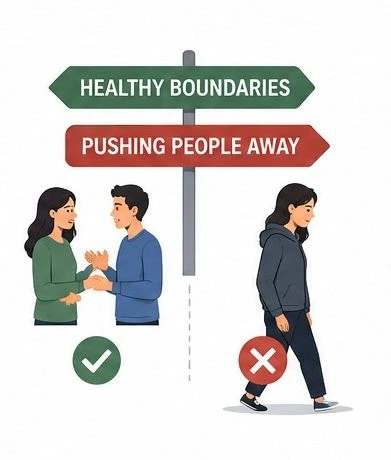
Healthy limits:
- You can use names for what you need and express this.
- This is a distance that is only temporary and in response to a given situation
- Go back and rejoin back
- The relationship is respectful to both parties.
- You are not guilty, you are not confused, you are clear and calm.
Pushing people away
- You vanish mysteriously
- The cause of closeness is not a particular action but closeness.
- When they go you’re happy they’re gone, then you feel lonely
- The pattern alternates with various individuals
- You’re unclear about your actions
So, why do I push people away for the little space I need. The difference lies in the fact that healthy boundaries are stated clearly, pushing people away is usually done out of fear, and not out of a need to have some distance.
What Research Says About This Pattern?
Attachment Theory
Attachment theory reveals a very painful truth: people who fear abandonment often distance themselves from others. They desperately crave closeness, but whenever someone is close to them, it makes them feel uncomfortable or threatened, which causes them to push people away.
Personality & Psychometrics (2025)
A 2025 personality and psychometric study confirmed that whenever you fear abandonment, it creates a fear of insecurity. That is, whenever you fear being alone, you develop anxiety, and you cannot create positive stability in any relationship because of this anxiousness. This is not a personality flaw, but a psychological cycle, and you can break the cycle.
Psychology of Women Quarterly (2024)
A 2024 study found that people who have experienced attachment trauma are very sensitive in their current relationships. Even the slightest disagreement is a sign that the person in front of them feels like a betrayal. Therefore, they may withdraw from people in their current relationship at the slightest sign due to past trauma.
After recognizing the why do I push people away and seeing how it works, it’s less difficult to begin to change the pattern.
How to Stop Pushing People Away: Steps That Actually Help

These steps are not meant to be taken quickly. But if you want to open your heart to people and trust them, then working through these steps one by one every day will help you immensely.
Notice the trigger, not just the behavior:
Notice the moment when something triggered you, and you immediately decided to distance yourself from people. As this thought comes to mind:
- Was there anything that bothered you?
- Did someone feel close to you, or did you find their closeness uncomfortable?
- Or was there anything that felt too deep?
Whenever such kind of thoughts come to you, write them down and take note of them. The problem will not be solved until you realise what happened and why you distanced yourself from the person in front of you.
Pause before you pull away:
Whenever you are close to someone, or for some reason, you feel the need to distance yourself. Before reacting, wait for a moment. Take a deep breath, and ask yourself this question: Is this the reason I am reacting to what’s happening now, or has it happened to me a long time ago? When you ask yourself this question, you will likely receive a very honest answer, and you will be surprised. This gentle push will stop your automatic reaction, and no one will be hurt.
Say it clearly instead of disappearing:
At any stage in your life when you feel you need space, instead of suddenly disappearing, tell the person honestly whether you need space to be alone in this relationship for a while, or whether it’s not about you. Saying all this is enough. Your situation may be handled well by saying all this, but for those who don’t tell the truth, such a situation becomes difficult to handle, and that’s why they disappear.
Question the story you are telling yourself:
Every story you create in your mind, write it down as you wish. After asking all these questions, ask yourself, do I have proof of all this, or am I thinking this because of my past? Sometimes, due to our past life, we are pushing such people away from the things that are happening in our present, and we ourselves are not aware of it.
Start with small acts of vulnerability:
You don’t have to share every secret of your life at once in a day. Start sharing just a little thing every day. This way, gradually, your trust will be built, and your inner closeness will develop. Sharing small things creates a sense of comfort that proves very helpful in healthy relationships.
Seek help from a Psychologist:
If you feel your problem has been ongoing for a considerable amount of time and you don’t see any improvement, you should reach out to your Psychologist. A Psychologist does not make a judgement; they listen to you and come up with a solution that is suitable for the problem.
Conclusion:
There isn’t one single answer to the question, why do I push people away? It is fear for some, past experiences or attachment wounds for others. The conclusion we’ve reached in this article is that your distancing yourself from others is a habit, not a personality. You adopt this habit for your own safety, to protect yourself from others. But this habit is now distancing you from relationships that are very important in your life. You don’t change overnight, but if you make some type of effort to change, change will come to you slowly. You just need to think deeply, pause for a while, and think, and things will begin to fall into place.
Reminder:
If you’ve been pondering on why do I push people away for years, then realize that change takes time. Being able to identify the pattern is a great first step to healthier relationships. Give yourself some time to settle the results. This is a pattern that has been in effect for a while, so it will take some time to break. Those who separate from you don’t do it because you are unworthy of them, but because you don’t know why you are doing it, and now you do. Now it’s time to change everything. You need to heal yourself; there’s no need to rush. Then and now, the right people are with you.
Disclaimer:
All the information provided in this Savvy Psych article is based on personal experience and mental health studies. If you have any serious mental health issues, seek help from a licensed therapist.
Sources & Further Reading
Bowlby, J. (1969). Attachment and Loss: Vol. 1. Attachment. Basic Books. APA overview of attachment theory
Bartholomew, K., & Horowitz, L.M. (1991). Attachment styles among young adults. Journal of Personality and Social Psychology, 61(2), 226–244.
Ainsworth, M.D.S., et al. (1978). Patterns of Attachment. Lawrence Erlbaum Associates. Attachment overview Psychology Today
Psychology of Women Quarterly (2024). Attachment trauma and relational hypersensitivity in adult relationships.
APA (2025). Cognitive behavioral therapy for attachment and anxiety
Eisenberger, N.I. (2012). The pain of social disconnection. Nature Reviews Neuroscience, 13, 421–434.

4 Comments