
How to Say No Without Feeling Guilty: 7 Simple helpful strategies
How to Say No Without Feeling Guilty is something many people struggle with every day. “No, I’m busy, I can’t.” Simple words. So why does saying them — and meaning them — feel like such a fight?
“No, I’m busy right now, I can’t do this.” Simple words, said with confidence, plenty of times by other people. So why is it so hard to say them yourself — and why does guilt show up the instant you do?
If you’ve ever agreed to something you didn’t want to do just to avoid the discomfort of refusing, or felt a wave of guilt the moment you finally said no, this is for you. With the right skills, it’s genuinely possible to build the confidence to say no without the guilt spiral that usually follows.

Why Does Saying “No” Feel So Difficult?
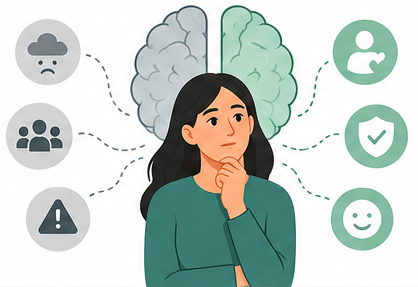
It’s not about character; it’s about wiring. Being excluded from the tribe or tribe group was a threat throughout history. The brain therefore developed a way of seeing disapproval, conflict, and rejection as threats. The consequence of this is that when we say “no,” the brain automatically questions, “Will they like me less now?
That feeling of guilt is not an indication that you have done something wrong; it is merely an old alarm system that triggers too quickly. Plus, there’s another wound. The notion that good people don’t say no was drummed into our ears at a young age, and saying “no” at home could have resulted in being called “difficult” or “stubborn,” and/or being loved only when you were being helpful to others, so it’s no wonder we feel guilty about setting boundaries. It’s not your fault. It is a lesson that was instilled in you at a very young age and reinforced time and again. There is another important aspect as well.
Research shows that women face more social criticism than men when they say “no.” This means that guilt is not merely an internal issue; sometimes, it is a reaction to a real social cost that we have learned about through experience.
You’re Not Selfish for Having Limits
Think of it this way: saying “no” is always saying “yes” to something else. It could be your time. It could be the energy you want to devote to the people who need you. Or, it may be your peace of mind. If you say ‘yes’ all the time, you will not get love; you will get exhausted. Silent resentment just accumulates over time – a resentment that others may not even realize they are asking for too much. A boundary is not a wall, but information. Helps others understand what you have to offer, avoiding disappointment later.

7 Strategies for How to Say No Without Feeling Guilty
Take a pause before answering.
If you immediately say “yes” but you are not really sure of the expectations being put on you, take a moment to regain your breath. I’m going to think about it and get back to you; that’s a full answer, too. Studies indicate that the most accurate choice is the one we will make after taking a brief moment to think. Once the heat has gone down, the proper response is evident.
Use the “positive sandwich”
Adopt the “Positive Sandwich” technique. Kindness and honesty can go hand in hand. This structure accommodates both: Try Acknowledgment: (“that’s kind of you to think of me”), boundary (“I can’t do it right now”), and a warm close (“I hope it goes well”). Notably, this does not include an apology or a lengthy explanation. This is intentional, which brings us to the next strategy.
Keep it brief — don’t over-explain
This is the most difficult thing. When you are in turmoil inside, you feel that you have to explain everything so as not to offend the other person. But talking too much, it makes it easier for others to disagree with you and not heal the wound. Your boundary ceases to be a boundary and turns into a question. “I won’t be able to do it”, that’s it. That is enough.
Repeat the same boundary calmly (the broken record technique)
Some people have trouble accepting a “no” the first time, and you will find yourself dealing with such a person. Don’t get frazzled. Calmly repeat your boundary with different wording. Don’t get into a debate or a long explanation.
Them: Just do it this once, please.

You: I understand, but it's not possible this time.

Them: You didn't used to say no before.

You: I hear you. Still, my answer is no.
This doesn’t mean you’ve become harsh. It simply means you aren’t engaging in a negotiation that was never on the table to begin with.
Offer an alternative, if you genuinely want to
Saying no to the whole request doesn’t mean saying no to helping at all. “I can’t take on the whole project, but I can help with the first part” can ease the situation without overextending you — as long as it’s offered because you want to, not because a full no feels too uncomfortable to leave standing.
Practice out loud beforehand
It may sound very simple, but it’s that simplicity that makes all the difference. When you are on your own, in the bathroom, when driving, anywhere, tell what you have to say out loud. So, when the time comes, you will have nothing to lose and not have to think of anything new under pressure. You will just be repeating what you’ve said numerous times before.
Let the guilt exist without obeying it
If you have some guilt after a reasonable, healthy no, it’s probably not a problem, just something new. Allow discomfort to exist, do not turn around because of it. The guilt fades. Without intervention, the chronic over-committment habit doesn’t…
Related on Savvy Psyche
Understanding the People Pleasing Personality: Traits, Causes, and Solutions
Negative Personality Traits: A Complete Guide to Identify and Handle Them
Fear of Judgment: 10 Ways to Stop Letting Others’ Opinions Control Your Life
A Real Pattern: Hania’s Story
 Hania was always the first person people turned to — for moving help, last-minute childcare, or any small favor. She rarely said no, quietly absorbing the exhaustion instead. The turning point wasn’t dramatic: a cousin asked her to plan an entire event with just two days’ notice.
For the first time, she said: “I cannot take on this responsibility — I hope it goes well.” No excuses, no lengthy justification. Guilt showed up right on schedule. She noticed it, and didn’t take it back. The event happened without her — no differently than if she’d said yes and spent the whole time quietly resenting it.
When This Goes Beyond Ordinary Difficulty
For some people, this goes beyond simply being overly caring. This is what psychologists refer to as “pathological altruism“: helping others so much at such a tremendous cost to yourself that your own physical and mental well-being starts to deteriorate. Speaking with a therapist could be beneficial if you observe these symptoms in yourself:
It may be worth speaking with a therapist if you notice:
- Your heart may want to, but the word “no” just won’t come out of your mouth, like your body won’t cooperate.
- Saying “yes” when you don’t want to is the norm, not the exception.
- You think about how the other person may feel if you said “no.”
- That guilt feeling, it doesn’t go away quickly; it stays with you for days, it casts a shadow over everything.
Therapy can shine a light on the origins, and provide strategies and techniques that are beyond words. Sometimes the load we take is not for the present but for the past many years.
Reminder:
Learning how to say no without feeling guilty gives you a sense of being more confident and balanced. It’s your right to think for yourself and take your own stand. If you are not happy with something, your voice is heard! Thus develop these skills and make your own ease.I know that these tips will come in handy for your guilty phase.

Disclaimer:
This article is based on personal experience and general psychology knowledge and is for informational purposes only. The information is not a replacement for information provided by a licensed therapist. Consult with a licensed mental health professional if you have a serious mental health problem.
Sources & Further Reading
Grenny, J., & Maxfield, D. — VitalSmarts/Crucial Learning research on emotional inequality and social backlash, based on a study of more than 11,000 participants. Full summary
Amanatullah, E. T., & Morris, M. W. (2010). "Negotiating Gender Roles: Gender Differences in Assertive Negotiating Are Mediated by Women's Fear of Backlash." Journal of Personality and Social Psychology, 98(2), 256–267.
Oakley, B., Knafo, A., Madhavan, G., & Wilson, D. S. (Eds.). (2012). Pathological Altruism. Oxford University Press. Overview




2 Comments