
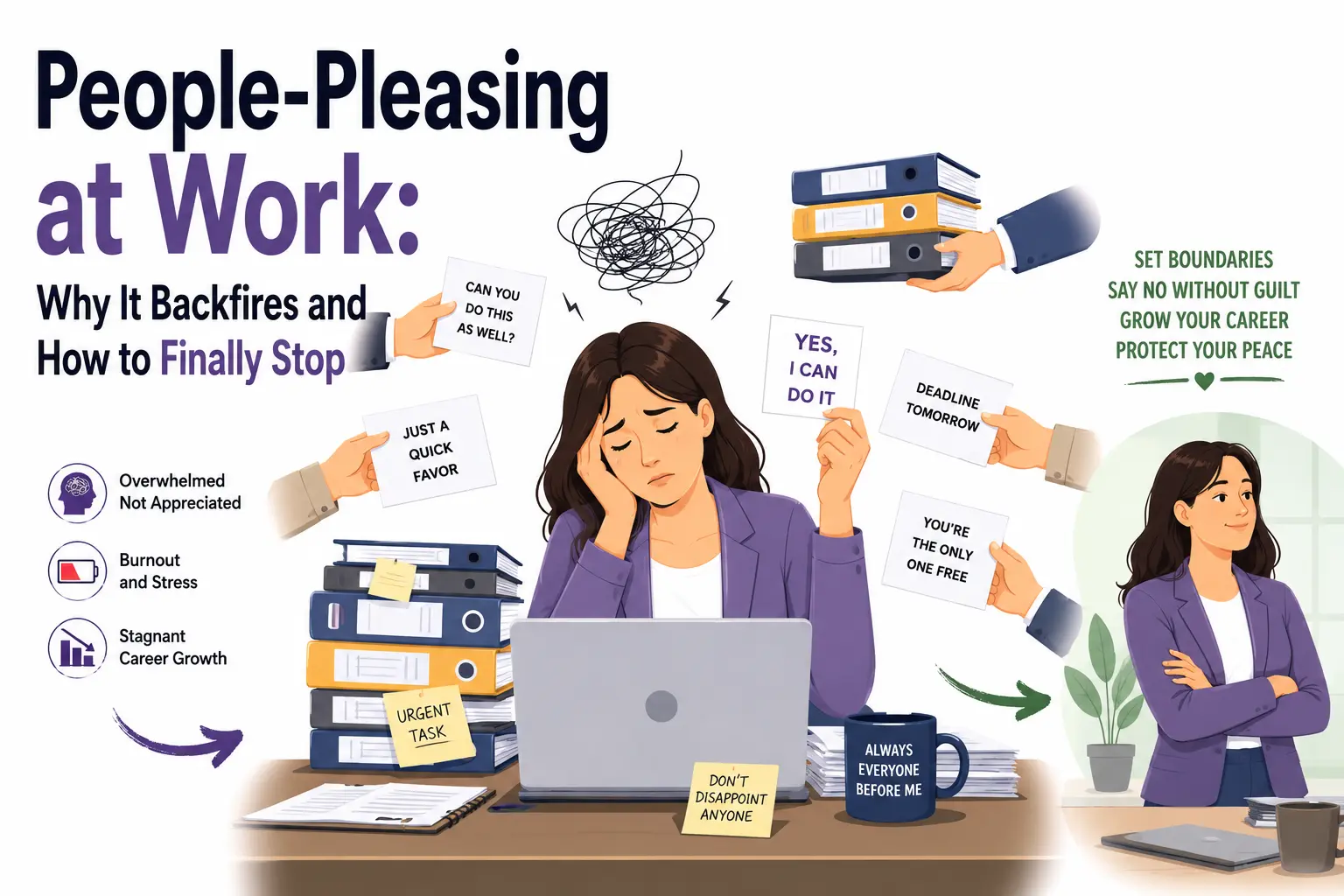
People Pleasing at Work: Why It Backfires and How to Finally Stop
You rewrote the email three times so it wouldn’t offend anyone. You smiled through being interrupted in the meeting. You said yes when you had no room left to give. And after all of it, you still haven’t gotten the respect or the promotion. This is the psychology of why, and exactly how to change it. Stopping People Pleasing doesn’t mean becoming a roadblock. It just means drawing your own line. Take back your voice, your peace, your dignity.
What People Pleasing at Work Actually Looks Like
People pleasing doesn’t just mean being nice. It means that every time you try to keep others comfortable, you end up hurting yourself. Your boundaries, your needs, and your professional reputation all fall by the wayside.
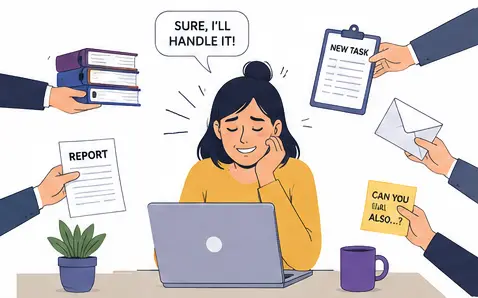
Here are the signs of it:
- Your plate is already full, yet you have to take on one more task.
- When everyone says something wrong in a meeting, you just smile and say “no”.
- You give 100 explanations so that no one feels bad.
- You do all that invisible work that will never be appreciated.
- You are the one who is responsible for the feelings of others just to be good.
- You play a scene in your mind after the conversation is over… “You should have said that there.”
The most dangerous thing? All this looks like collaboration from above “How helpful he is, “What a good team player he is… Because of this deception, it slowly eats you away.
Why You Can’t Say No at Work (It’s Not Weakness)
People pleasing is not your thing. It’s a survival strategy. And for most people, it started a long time ago. Psychology calls it Fawning. The fourth way to stress.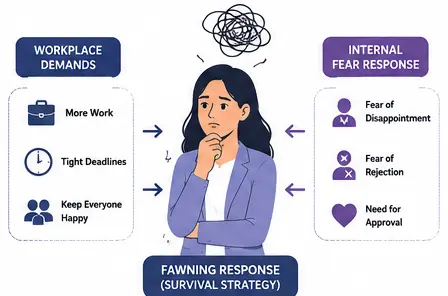
When in childhood you were afraid after every “no” lest someone get angry, lest they leave you… Then your brain learned: Keep calm, keep everyone happy, you will survive. That’s why even today you feel safe being agreeable. Time has passed, age has increased, but the pattern is the same. In the meeting room, on chat, during reviews… the same “don’t speak” mode is on everywhere. Although there is no one left to punish, who can explain to the nervous system? Understanding the root cause of people pleasing… that’s the biggest first step. Because unless you know why you formed the habit, you can’t break it.
What You’re Losing With Every “Yes”? (The Calculation of People Pleasing in the Workplace)

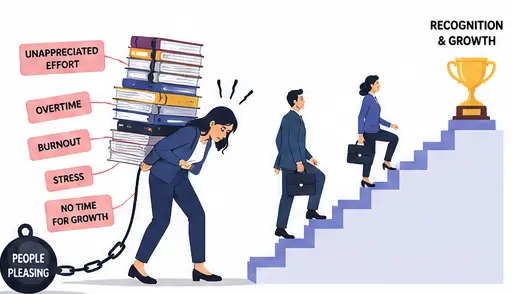
It quietly destroys your professional reputation.
It’s strange but true: People-Pleasers get less respect, not more. When you say yes to everything, the team will call you a “good person” but not “reliable.” Your “yes” will lose its value, because everyone knows you’re just a pushover. Then how can you hope to get promoted?
It quietly produces burnout
Clinical psychologist Dr. Debbie Sorensen has noted: When you’re constantly trying to be “helpful,” you sacrifice your own needs, your own boundaries, your own self… everything. The result? Deep-seated resentment and burnout. Overwork and overtime are the top causes of burnout, According to 2025 workplace data, overwork and unpaid overtime remain leading causes of burnout. Every uncalculated “yes” is, functionally, a contribution to your own overtime.
You become invisible while doing the most
Look at this injustice: You carry everyone’s burden, cheapen yourself with every “yes”. And then you wonder why people don’t “note” you? It’s simple. The world will not remember those who won’t speak up for themselves. Over-deliver but don’t raise your voice then you will always be in the Blind Spot.
It teaches others to take advantage of you
See how it works: You say a “yes” that wasn’t from the heart. The second “yes”. The third “yes”. People take note. They understand that your Boundary exists just in name. Then they make it a habit to be available to you all the time, to say yes to everything, and to keep quiet. Becoming Assertive Later? Brother, that will be like climbing a mountain.
Sarah’s Story: From Yes to Necessary
Names have been changed for privacy, but this is what actually happened and it may be happening to you too.
3 years. Same company. Same role. Sarah kept saying yes, every day until her body and mind gave up. That day, she realized: This fatigue wasn’t the kind that could be cured with 2 days off. From the outside, Sara was the perfect employee. Everyone liked her. Zero conflict. Her manager’s favorite phrase about her: “It’s fun to work with her.”
From the inside, it was a different story. No raise in two years. Passed over for promotion twice. The reason? People who worked less but were more vocal. Sara picked up everyone’s trash, stayed late for everyone, kept quiet after listening to everyone’s ideas and the credit always went to someone else. Sarah’s voice was trembling as she said, “I thought a good employee was someone who could do everything. Someone who didn’t stop. I kept making myself useful every day hoping that one day someone would notice. Everyone saw it. But they didn’t respect it, they took advantage of it.
The deeper truth: colleagues did not see Sarah. They saw her “yes.” Her inability to decline made her the default overflow point for every task no one else wanted. The result was that she never developed deep expertise in any single area and expertise, not availability, is what promotions are built on. The team liked having her around the way people appreciate a safety net: comforting, but never chosen to lead. When the leadership seat opened, the team chose a leader. Not the safety net.
The turning point
(The day Sarah said “no” for the first time… and the world didn’t stop)
Six months and two missed promotions later, Sarah was still quiet until a Thursday at 3pm when her manager dropped an urgent campaign brief due Monday, the same day as an already-committed product launch deadline. The old Sarah would have said yes immediately, then spent the weekend in a quiet panic, working until midnight, wondering why this always happened to her.
This time, she paused. She breathed. And she sent a different kind of message: “Honestly, the campaign strategy needs real time to do well. I also have the product launch Monday. I don’t want either to suffer quality matters on both. Should we shift one deadline, or would you like me to focus on one while someone else leads the other?”
Her manager paused, then called: “Oh I had no idea the product launch was also on your plate. Let’s shift the brief to Wednesday. Should I get you support on the launch too?” No conflict. No damaged relationship. But something shifted quietly and permanently: Sarah started being consulted before decisions were made, not handed decisions after the fact. The casual “take this extra work” requests stopped. Four months later, her manager personally nominated her for Team Lead, explaining simply: “Sarah knows her limits and speaks up. That’s what a leader does.”
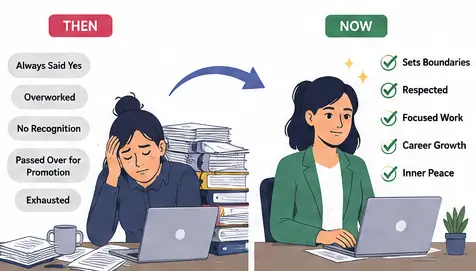
Truth be told? Sarah was no superhero. She was ordinary like the rest of us. What made her extraordinary was that one day she chose herself. She chose to protect her time, her judgment. That was all it took. And you can make the same decision. Today.
Related on Savvy Psyche
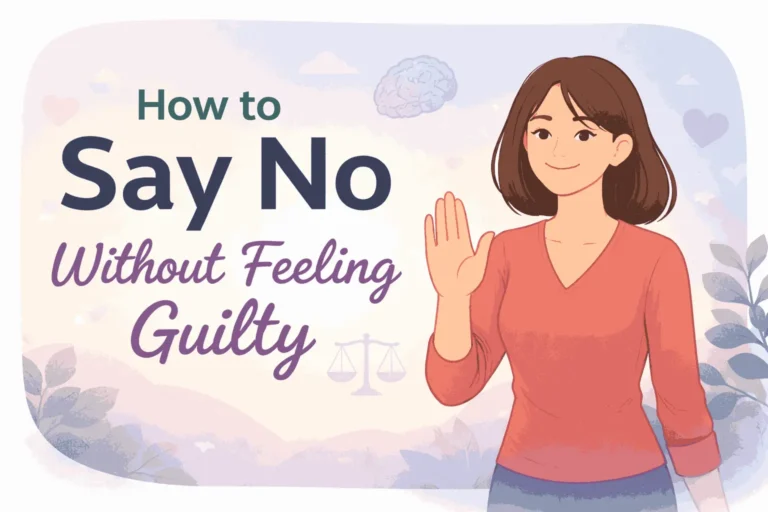
Understanding the People Pleasing Personality: Traits, Causes, and Solutions How to Say No Without Feeling Guilty: 7 Simple helpful strategies Workplace Gaslighting: 9 Signs It’s Happening to You & How to Stop It
What Research Says About Workplace People Pleasing
Psychology Today Rejection Sensitive Dysphoria
Cognitive Dissonance at Work
Chronic stress research
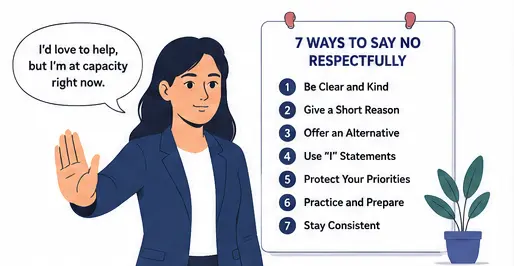
Stop People Pleasing: 7 Ways to Say No Respectfully at Work

Put a Full Stop on the Immediate Yes
Today, right now, that’s what can make the biggest difference. No course, no book. Just a 3-second pause before saying “yes.” This is what will turn you from an employee to a professional. Someone asks you for a favor, gives you a task, asks for your opinion, asks for your time What is your first reaction? Answer immediately. And this is the symptom of the people pleasing disease: Say “yes” without thinking. Because you are afraid to say “no”. Just turn off the Auto-Pilot “Yes”.
If someone asks for something, keep these 2 phrases in your pocket:
I’ll check and let you know
I’ll confirm after 24 hours.
You shouldn’t make every decision right away. Hasty decisions always hurt you.
Learn the difference between I am valuable and I am useful
This is a straight forward statement, but it is important to understand: Many people-pleasers do not realize that they have come to see themselves as just a “useful thing”. They think that the boss’s yes, the team’s praise, everyone’s approval that is their salary. And until this belief is broken, the “yes yes” machine will not stop. Your reputation is based on how well you make decisions. How well you do your work. What value do you add? Not on how much you say “yes” to everything. You are not a convenience store owner who is open 24/7.
Start saying no to small things first
Don’t rush, my friend. The yes of your whole life won’t turn into no in one day. Start from where your heart is light. Someone like that, a job where you can sleep at night after saying “no”. When you learn to win small risks, big risks will seem easy.
Practice 3 things every day, just:
- Avoid unnecessary meetings.
- Without guilt. Ask “why” on minor changes.
- Don’t agree to everything. Don’t give false deadlines. Say what can be done.
Decline without apologizing
“No” is not a crime. So why write an apology? Remember the 3-line formula, the work will be done:
- I can’t do it right now. X and Y are my priorities.
- I don’t have time this week, so-and-so will do it.
- If I say yes, the quality will suffer, and I’d rather be honest about that now.
These statements are not excuses. They are status updates. This is the precise difference between rudeness (“do it yourself”) and assertiveness (“I can’t do this”) and the difference is enormous.
Learn to tolerate disappointment.
This step is difficult, but this is the Master Key. Tell me the truth? You don’t run for work. You run from discomfort. You can’t stand the discomfort of the person in front of you. So as soon as someone gets angry, you become a Scrambler: Sorry + cleaning + extra work. All at once.
More than saying “no”, the 10 seconds of silence after “no” are harder to win. “Someone’s reaction is not your responsibility.” You are not disrespecting. You are just saying “no”, respectfully. And remember: if the other person gets angry, it is not proof that you are wrong. Practice. The first time will hurt. The 5th time will become a habit. The 20th time will become a strength.
Speak plainly stop softening your language into ambiguity
Whether it’s WhatsApp or a meeting, do one thing: check your message. We People-Pleasers wrap the real thing in soft language and kill it. We turn “I can’t” into “I’ll see if I get time.” The result? The person in front of us understands “Yes” Don’t be soft. Be clear. Directness is not about hitting; it’s about telling. We are afraid that “if I speak directly, there will be a fight”. But the truth is: A Clear person in the office is trusted. A person with “maybe” seems risky. A person with “yes/no” seems reliable. Trust does not come from shouting. It comes from Clarity
Go from “what will they think” to “what am I”
 There are two types of respect. Agreed: “Agreed, dude, this is great. Trusted: “Do it, it’s the truth.
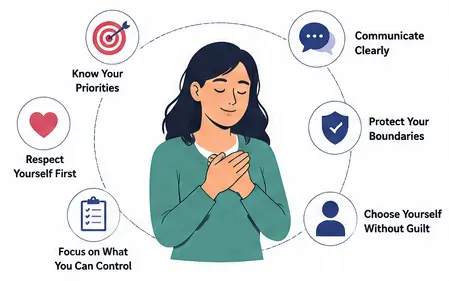
The second type of respect is only given to those whose professional standards are clear. They have a clear idea of their red line. They speak up. No matter if someone argues someone gets angry, they don’t change their position. No one cuts down a tree that is shaking. Everyone takes shelter in a strong trunk.
Pause before responding and ask: “What is my real position here? What do I stand on?” Then speak from that place. Not from the “What can I say to please him” place. See the difference: When you speak from one place, it seems weak. When you speak from another place, it feels powerful.
Reflexive people pleasing script

Manager: "I need this full report by tomorrow morning." You: "Yes, sir." (Internally: heart rate spiking, already dreading the night ahead.)
Assertive, professional script

Manager: "I need this full report by tomorrow morning." You: "I want this done well, so I want to be upfront I'm currently committed to X and Y. If this report is the priority, which of those should I pause? I want to give it the quality it deserves."
Traps to Avoid While Changing the Pattern

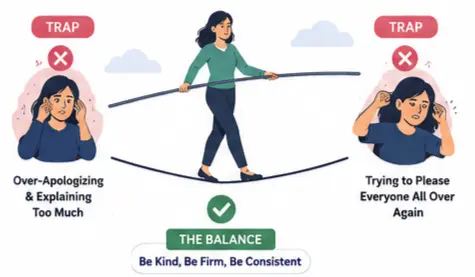
I won’t listen to anyone anymore” Syndrome
If you learn to say “no”, don’t bring attitude. Some people get up from the mat and become a sword. But we don’t need a sword, we need a compass. Don’t be an enemy, be yourself. Be warm. Smile. Show respect. Say “no” at the same time. People are afraid of this: A person who is gentle, but not weak.
Direct + Kind = Respect’s Formula.
The new me overnight trap
The result of Overnight Change Been a “Yes Person” for 10 years, and today suddenly became a “No Machine”. Team will think: “This person has changed, is no longer trustworthy”. No Boundary created, no respect. Relationships damaged. The rule is: Start small, cook. First, say “No” only to “Last-minute request”. Then say “No” to “Weekend work”. 1-2 Behaviors at a time. Keep saying “Yes” to the rest. Give people time to adjust.
Treating guilt as proof you did something wrong
The heart is getting bad means the work is being done, Why does Guilt come as soon as you set a limit? Because your mind thinks: “Oh, I didn’t keep everyone happy. Now we will be kicked out of the group”. In the old days, leaving the group = death. Today, it is not death, only discomfort. So, when Guilt comes, welcome it. Say: “Hello, old friend, are you here?” It will take weeks or months. Then one day will come You will say “no” and sleep peacefully. When it becomes familiar, fear will disappear.
Waiting for the Perfect Moment
Confidence doesn’t wait; it comes after First day at the gym: Dumbbell too heavy. 6 months later: Same dumbbell too light. “No” is the same. First time = Heart rate increases. 50th time = “Well, that’s what I was going to say?” If you wait for Confidence, ages will pass. Confidence is waiting for you to take the first step. Action → Experience → Confidence.
That’s the Formula, not the other way around.
Final Thoughts: Respect Starts From Within
Respect at work does not just fall from the sky! No manager, no colleague and no promotion cycle will get you out of this trap of automatic agreement. Receiving a “yes, of course” for any answer will never make you a leader. Yes, you will be scared at first. People will be surprised. Some will even get angry. But then the magic happens: your “yes” will mean something. Your promises will be fulfilled. People will trust you because you have become Real. Respect is not bought. It is earned by drawing your own line. No one will come to save you; you will save yourself. Remember: When you learn to say “no”, then your “yes” will be valued.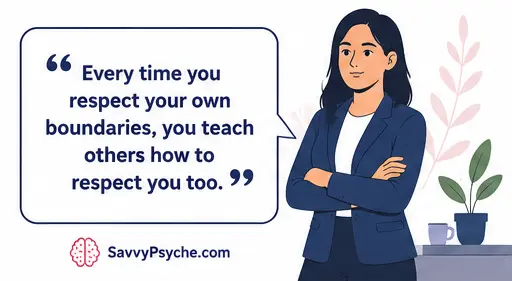
When to Seek Professional Help
The above strategies are meaningful strategies to shift the people pleasing in the workplace for most. However, the pattern of relational trauma which lies beneath, or the link with chronic anxiety, burnout or depression, magnifies the change when it is facilitated by professional support.
- Chronic fatigue, fear, or unease that is particularly work related and does not go away with rest.
- The fawning pattern permeates through more than just the work; it’s in most or all of your relationships.
- You think that the source of the problem goes back to childhood, which has not been dealt with.
- You have been trying these strategies over and over and still aren’t able to maintain even small boundaries.
Disclaimer:
The information and education provided in this article are for informational and educational purposes only. It is not a psychology professional advice, diagnosis or treatment. The case story shared has been anonymised with changes to names to protect confidentiality. If you are having any problems with your life due to silence, suffocation or chronic workplace stress, please seek out a licensed therapist or mental health professional.
Sources & Further Reading
Walker, P. (2013). Complex PTSD: From Surviving to Thriving origin of the "fawn" stress response framework. Psychology Today overview of fawning
Psychology Today: Rejection Sensitive Dysphoria overview
Festinger, L. (1957). A Theory of Cognitive Dissonance. Stanford University Press.
Maslach, C., & Leiter, M.P. (2016). Understanding the burnout experience: recent research and its implications for psychiatry.
APA: Workplace stress and chronic stress effects
Sorensen, D. clinical commentary on people-pleasing, boundaries, and burnout in professional contexts.



4 Comments