
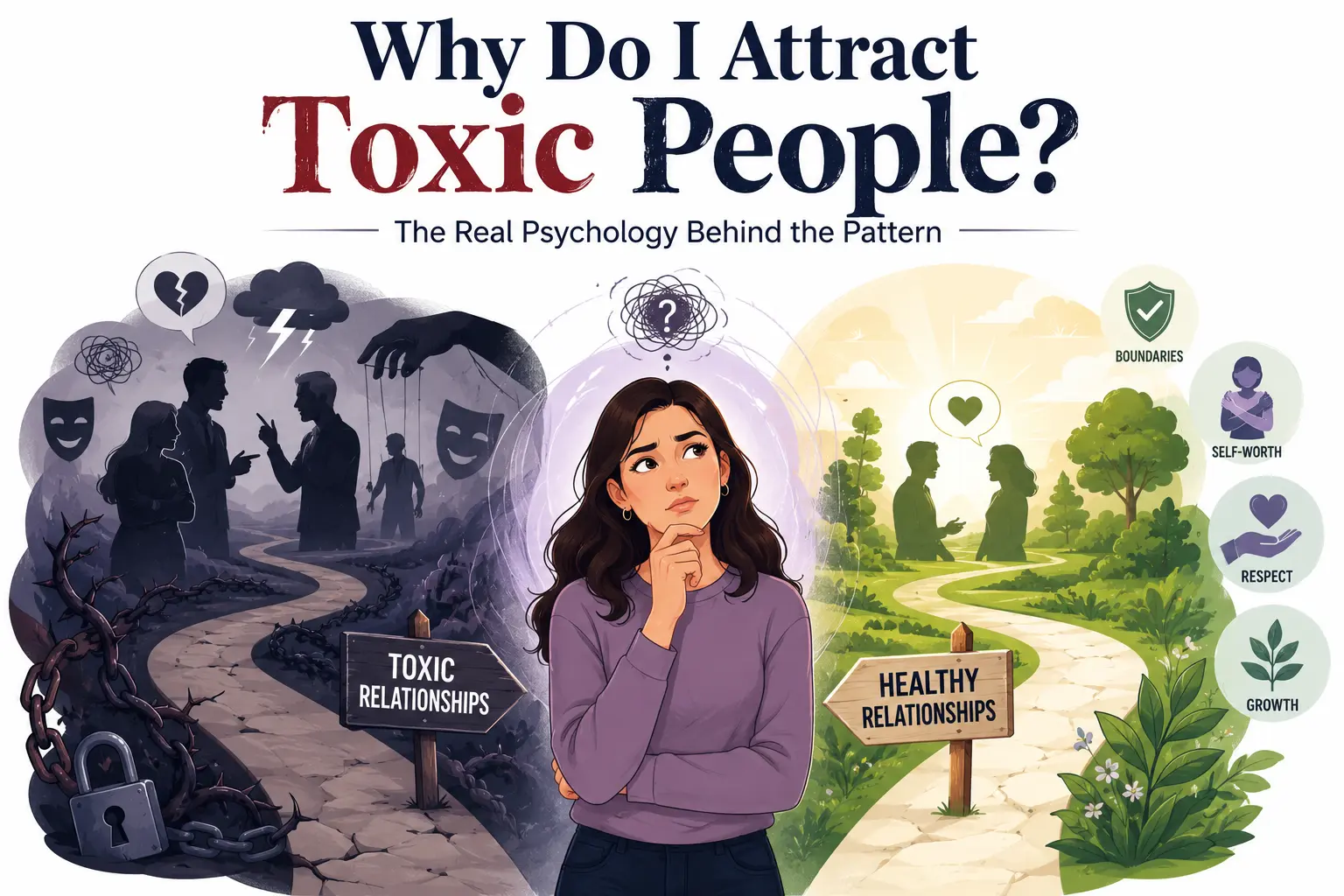
Why Do I Attract Toxic People? The Real Psychology Behind the Pattern
If you’ve ever wondered, “Why do I attract toxic people?” you’re not alone. This time, you really meant it. “Enough, no more”. Deleted the number of that friend whose words were poisonous. Said goodbye to that love that only took and gave nothing. And that office guy who, even standing next to him, seemed like you were making a mistake. Keep your distance from him. And then what always happens happened.
Without realising it, a new laugh, new words, new attention came into my life. At first, I thought, “Maybe this is the difference.” His words, his style, that little bit of intensity everything felt good. Then 2-3 months passed. You were still tired, still confused. And at night, looking at the ceiling, the same question: “Man, how did I get stuck in this cycle again?”
If you’ve ever asked yourself, “Why do people like this come with me?” Then this article is for you. Not to blame. Not to give a list of red flags. Just to explain what’s going on inside. And why does this cycle repeat itself, even if you know everything? Just knowing is not enough. Until the cause is understood, the cycle is not broken. And change begins there.
First, let’s define this… Who are you talking about, “Toxic”?
The word “toxic” gets used for almost everyone now But stop. Let’s clear one thing before going further. (Because not every bad person is toxic. And not every toxic person seems bad) A person who sometimes spoils the mood, or speaks harshly by mistake is not toxic.
So, who is toxic?
The one who has a “pattern”. A habit.
He will twist the subject every time. He will make you feel small every time.
He will cut you off every time. He will suck your energy every time.
Not once or twice… repeatedly. That’s the difference.
What is the hallmark of a toxic person? See:
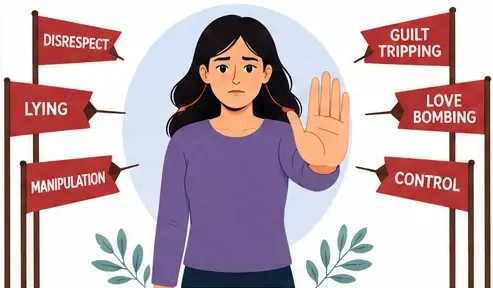
- Lies/Manipulation – Truth is not in their dictionary
- Mood Bomb – Happy today, fire tomorrow. And it’s your responsibility to handle it
- “I’m never wrong” – It’s your fault for everything
- Guilt Trip – Talking makes you seem like you’re very bad, or crazy
- One-way street – You give, you listen, you understand… He just keeps taking it. If it happens once or twice, it’s human. Every time, it’s a pattern.
Everyone is difficult sometimes. The difference is:
Normal people are hard to deal with at times. Toxic people are hard to deal with by nature and the defining characteristic is that they will never take responsibility.
There Is No Coincidence There Is a Pattern
Here is a truth that is rarely said directly: The people who are coming into your life… It’s no coincidence. You “let them in” – that wasn’t a coincidence either. You “stayed” with them – that wasn’t just like that either. And you slowly gave them the key to your personal space, your words, your heart… everything. All of this was no coincidence either. Something is going on behind the scenes. There is no blame here. Understand the point. If there is a pattern… then there must be a root, right?
This is what science says: We unknowingly repeat the same people, the same drama, the same pain… which we feel “like ourselves”. Why? Because the brain feels “familiar” = “safe”.
Although it is not safe, if you have seen the same environment since childhood, the brain forgets to differentiate. If you grew up in pain, your nervous system concludes: “Yes this is what normal feels like.”
8 Real Reasons You Attract Toxic People
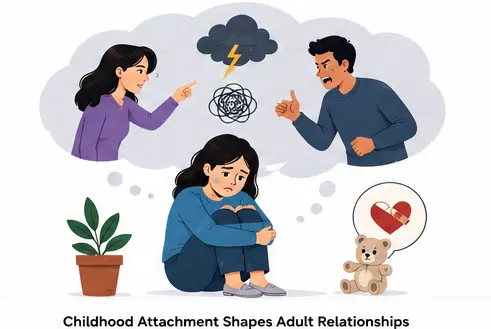
Childhood relationships became your template

This is the hardest thing to accept. But it also makes the most sense. The relationships you saw and endured in childhood… became the “map” of your mind. In psychology, this called Attachment Style. And this determines who you will be comfortable with, who you will be attracted to, and what you will tolerate. If love at home meant obedience, silence, or unpredictable moods, three beliefs lodged themselves in you without your consent:
- I am not worthy of love
- Love = perform
- Relationship = with fear. You did not create these beliefs yourself. Childhood put them in your mind.
Now, understand the real mechanism:
When you grow up and meet someone who repeats the same old drama…
Whose love is not ripe, whose mood you feel responsible for, who is sometimes hot and sometimes cold…
Then your mind does not see the threat. It sees “familiar”. That pull you feel, even when everything seems wrong? That is not “chemistry”. That is the old pattern.Low self-worth creates zero boundaries

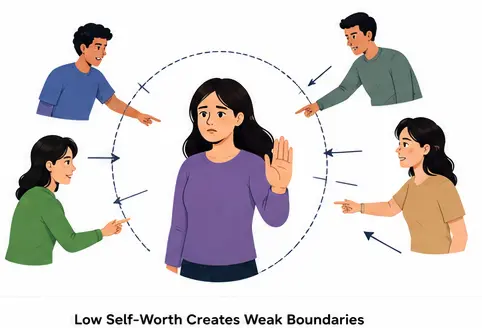
People with strong self-esteem rarely come to toxic people. And even if they do, they can’t stop. Why? Because as soon as someone does something rude, they take it seriously. They say “no.” But when you yourself are not sure that you are worthy of respect… or feel that you have to earn your place in a relationship… then toxic people realise it. There is no conspiracy. It’s just that people who don’t take responsibility, they want people who don’t ask questions.
Low self-worth is seen silently:
Always putting the needs of others before your own, settling for less than you want even when no one has said it, then having a hard time convincing yourself, “Okay, that’s fine,” finding it difficult to say “no,” feeling “thank you” for even basic respect until you’ve given 100 reasons, like kindness. If any of these things are said… then listen carefully. Not to criticise yourself. To understand.
You have mistaken intensity for intimacy
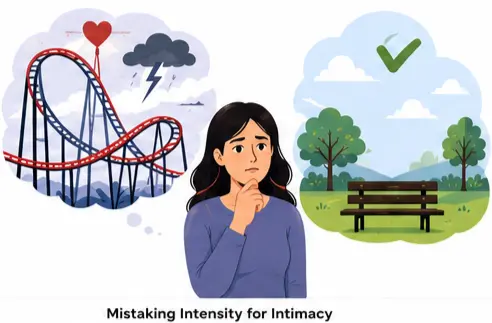
If childhood was turbulent, the brain learned: Drama = love. Silence = danger. Peace = happiness. So now you find calm boring. And storms seem “deep.” But intensity doesn’t mean intimacy. It’s often a substitute for intimacy.
A true relationship is calmer, more stable, and less exciting at first. That’s why when your mind is used to the chaos, a healthy relationship feels boring. The depth isn’t lost. It’s just that old fear “charge” is missing. Toxic people are experts at creating this charge. Sometimes they make you the special person in the world, sometimes they disappear so much that you become air.
Your mind is always on alert, waiting for the next change. This is not love. This is a disorder of the mind that looks like love.
You are very empathetic and that is what is being exploited.
Empathy is the most valuable human quality And it is the quality that is most benefited by those who lack empathy.Highly empathetic people:
- Keep giving others a chance,
- Continue to accept bad behaviour even against evidence,
- Take responsibility for the other person’s mood instead of setting boundaries,
- Don’t let go of someone who is hurting you if they are unhappy.Narcissistic and cunning people, knowingly or unknowingly, are drawn to empathetic people. Your compassion becomes a shield for them. They will say: You can understand how difficult my life has been.This sentence seems familiar, right? There is nothing wrong with empathy. But when empathy has no limits… when you ignore your own needs, your feelings, over and over again. Then it is no longer a strength. It becomes a weakness.
You don’t trust your gut feeling.
This is subtle but very important. People who are often caught in toxic relationships have learned at some point not to trust their feelings. Perhaps in childhood, they were told, “You’re too sensitive, you’re acting, you’re misunderstanding. Or perhaps your perspective was always refuted in a relationship. Psychology calls this Gas-lighting.
When you are not taught to trust your own thoughts, your alarm bells go off. You see the red flags. You feel anxious. But then you prove yourself wrong. You keep saying, Maybe I’m wrong. Toxic people thrive in that space between feelings and not acting.
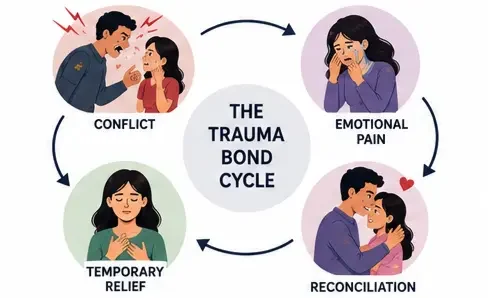
Trauma Bond: When the mind knows, but the heart doesn’t believe
This is the most important reason on the list. Because it explains why people stop even after understanding everything.Trauma bonding is a brain reaction.
Toxic relationships follow a 4-step cycle:
Fight → Pain → Reconciliation → Peace.

And the “relief” of a moment of reconciliation feels like an addiction to the brain. Dopamine increases in good moments. Cortisol in bad moments.Gradually, the brain becomes accustomed to this cycle itself.That’s why you know 100% that this relationship is breaking you, yet your heart pulls back. That pull doesn’t come from logic, it comes from the mind. It’s not stupidity or weakness.Because of the trauma bond, just “understanding” is not enough. This attachment is deep in the brain. To break it, it takes not only intellect, but also action.
Abandonment Fear:
You find the fear of “being left alone” greater than the fear of “being mistreated.”
This is the most painful truth of relationship psychology. And the most common.For people who are very afraid of being alone, the fear of “being abandoned” seems to be greater than the reality of “being treated badly.” That’s why they unconsciously tolerate bad treatment… just to avoid this fear of being left alone, ignored, or “unlovable.”Think of it as a game? Toxic people do this – intentionally or habitually:
Step 1: When you get close to them… they will move away.
Step 2: When you ask, “Where do we stand?”… they will avoid answering.
Step 3: They will make you fail, saying, “You have to earn their company”. What will your mind do now?His bad behavior: 6/10 pain Fear of them leaving: 10/10 pain. The mind will immediately say: “He doesn’t scream… He is just there. Prove that you are worthy of love.” This is not your weakness. This is a sign of being human. A child who was scared in childhood, If you cry, I will leave you… will do the same when he grows up. But remember the rule: A wound that has no name never heals.
Today, we have named it: Abandonment Fear.People-Pleasing:
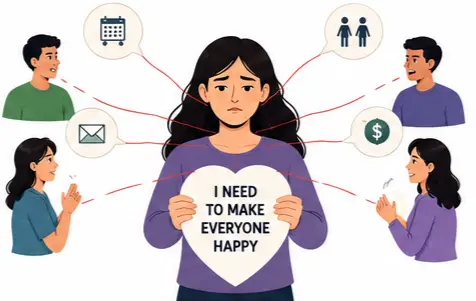
The wound that doesn’t teach you to say “no”

People-pleasing is not a habit; it is a psychological way of escape. It is formed in an environment where keeping others happy = staying safe.If, as a child, you had to constantly read the environment, handle the moods of adults, or keep peace at home at your own expense then you subconsciously learned to put other people’s feelings first, and your own after. It was not a choice. It had become a reflex. What’s the problem?
Toxic people pick up on this reflex of yours. Their moods are never the same. Their needs are always loud. Their anger feels immediate to you.And your nervous system – trained since childhood to fix the hurt before it gets worse – goes into overdrive.You’re not weak. You’re the one whose habit of “making everyone happy” once saved you. Now the task is to teach your nervous system that it doesn’t have to do that anymore.
Related on Savvy Psyche
Why Do I Get Attached So Easily? Causes, Signs & How to Stop Emotional Attachment Why Do I Push People Away? 5 Hidden Reasons & How to Stop How to Say No Without Feeling Guilty: 7 Simple helpful strategies
Real Story: This is not all on paper, this is how it happens in life
Let’s understand this from real life.
Sara grew up in a house where there was no account of the love of her mother/father. Sometimes she would do everything right, but still she would get apathy. Sometimes a lot of love for the smallest thing. She learned: you have to work hard for love. And if you don’t get love, it’s my fault.
As an adult, Sara’s relationships follow the same pattern. She is always drawn to people who are sometimes very nice, sometimes very cold. She is always the one who messages, apologizes, and finds reasons for their bad behavior. When friends explain this pattern to Sara, she starts defending these people. You don’t see the good in them.” “It’s not that simple.” “I’m not perfect either.” Sara isn’t choosing toxic people because of poor judgement. She’s choosing them because they seem “familiar.”
Her brain hasn’t yet learned that “familiar” and “safe” can be in the same relationship. That’s the pattern. And it’s not about being stupid or weak.
The moral is not that Sara made bad decisions.The moral is that Sara made “familiar” decisions. And the day she understood where this pattern came from that day her guilt disappeared. You can’t judge by difference until you see the truth. And now Sara is seeing the truth.
What Research Says About This Pattern
Childhood psychology, 2024
Research on abandonment fear has always been linked to the experiences a child has in childhood, namely that the child is not important. If a parent rejects and/or neglects to consistently provide a child with emotional support, the brain learns the lesson that I am expendable. This lesson won’t go away with the years. It is the prism through which all future relationships pass.
Attachment theory
Insecure attachment anxious, avoidant, or both
Research says: This fear creates anxious, avoidant, or both.
When parents fail to be consistently emotionally supportive, two patterns are likely to emerge: clinging (anxious attachment) or distancing (avoidant attachment); and some will oscillate between the two, a pattern referred to as disorganized or fearful-avoidant attachment. In any of its forms, insecure attachment forms who people feel comfortable with, who people feel safe with, and what type of toxic relationship one will likely overlook as being toxic.
Self-fulfilling prophecy research
Research says: Fear makes you clingy, possessive, manipulative → leads to self-fulfilling prophecy your language: The closer the relationship gets, the more the fear grows. Then you cling, possess, and test. The person in front of you shrinks and walks away. And you say, “See, he left me.” Fear fulfills its own prophecy.
How to Stop Attracting Toxic People 5 Steps That Actually Break the Pattern
Start every new relationship slowly
Rushed relationships are a warning signToxic people move too fast in the beginning. They will say “you are my soulmate” in 1 week. This is not flattery, it is cheating. Going slow gives the brain time to think. The racing heart needs a break from the brain. Let the relationship unfold on its own. Don’t rush.Learn to tolerate pain, don’t fix it right away
The fear of leaving seems greater than the pain of stayingMost people don’t leave toxic relationships because they are good. Rather, it is because the fear of “being alone”, the fear of “change”, the fear of “not knowing what will happen”… seems greater than the poison of staying. Through therapy, by making small decisions, learn that you can survive even in uncertainty. This is real strength.Make friends with your own needs
Stand in front of the mirror and ask:”When do I get nervous while expressing my needs?
What do I say sorry for when I’m not sorry at all?” Ask for water → “Sorry, did I disturb you”Ask for sleep → Sorry, I sleep too much”Ask for respect → Sorry, I’m sensitive.
You are apologizing for being human. Like breathing is a crime. The truth is, your needs are not a burden; they are a foundation, Food, sleep, respect, peace, the right to say no These are not excessive. These are basics. The day your mind accepts this That day, you will get up and leave.Learn the difference between red flags and hard times

Everyone goes through hard times The red flag is not that he is worried. The red flag is that, in the name of worry, he always needs you, twists the truth, and puts all the blame on you. Whatever you see, write it down on paper. Write the truth. The mind forgets, the paper does not. The pattern is exposed on paper.Consider therapy specifically, attachment-focused work
These patterns come from the roots. It all stems from childhood. A good therapist doesn’t just tell you what’s going on. He or she changes the map of your mind that often draws in wrong relationships. This is the deepest work. And it brings about change where it’s really needed.
4 Costly Mistakes While Trying to Break the Cycle
Focusing only on spotting toxic people, never on your own pattern
Reading 100 Red Flag articles on the internet won’t do anything unless you ask yourself, “Why didn’t I find that behavior offensive? Why did it seem familiar to me?” If it seemed normal to you, then the reason is your childhood, not the boy.Running away from the wound and entering the grave
After a painful relationship, the heart wants to cut off everything. But loneliness makes the problem worse. Real healing comes from healthy relationships. The same wounds that were inflicted by wrong relationships will be healed by the right relationships.Mistaking diagnosis for cure
Lesson: Just knowing is not enough. Change comes from small daily practices. And don’t fight this battle alone – have someone to hold your hand.Swinging from no self-blame to total self-blame
In the cycle of giving up people-pleasing, many people go to the other extreme. They blame everything on themselves. “I did this wrong, I am like this, I am like that.” Healing is not self-blame; it is self-understanding.
When to Seek Professional Help
This can change over time if a person is self-aware and takes the steps outlined above.
However, for certain individuals, especially those who experience childhood trauma with trauma bonding, or relationships involving real danger, professional assistance is a must.
It is necessary.
- Your pain is debilitating or you are experiencing a lot of difficulty sleeping due to your pain
- You know what is right but don’t have the strength to do it
- You are currently in an Abusive, Controlling or Threatening Relationship.
- This pattern goes back to childhood experiences which were not adequately resolved.
Conclusion:
If you’ve read this far, you’ve woken up. Are you feeling pain? It’s the prick of waking up. It means the pattern is no longer hidden. And what is visible cannot blind you. The truth is: there is nothing wrong with you. You are not “attracting” toxic people. You are just repeating the template written in childhood. Your nervous system had learned that “relationship = this is how it happens”. But listen… the template can be erased. The pattern can be broken.The map you got in childhood is not your destiny. And the biggest thing: you refused to accept “destiny”.”Why with me?” Asking this question is the first line of the new story.
Reminder:
If the pattern is visible, then it can’t run you anymore. You are not broken; the software is old – It can be updated. You are not bad. Change the map, the house will change – Copying your father’s design is not obligatory. Asking questions is courage – Those who say “luck” lose. Those who ask questions win. Don’t underestimate that question. This question will take you from the old you to the new you.
Disclaimer:
This article is written in the light of mental health education and personal experience. This is information, not treatment. If your pain is severe, you are having trouble sleeping at night, or you are finding it difficult to cope please don’t fight it alone. Talk to a licensed therapist or psychologist. This is not weakness, this is courage.
Sources & Further Reading
Bowlby, J. (1969). Attachment and Loss: Vol. 1. Attachment. Basic Books. APA overview of attachment theory
Ainsworth, M.D.S., et al. (1978). Patterns of Attachment.
Dutton, D.G., & Painter, S. (1981). Traumatic bonding: The development of emotional attachments in battered women and other relationships of intermittent abuse. Victimology, 6, 139–155.
Carnes, P. (1997). The Betrayal Bond: Breaking Free of Exploitive Relationships. Health Communications Inc.
Psychology Today: Codependency and relationship patterns
APA: Recognizing and addressing relationship abuse

2 Comments