
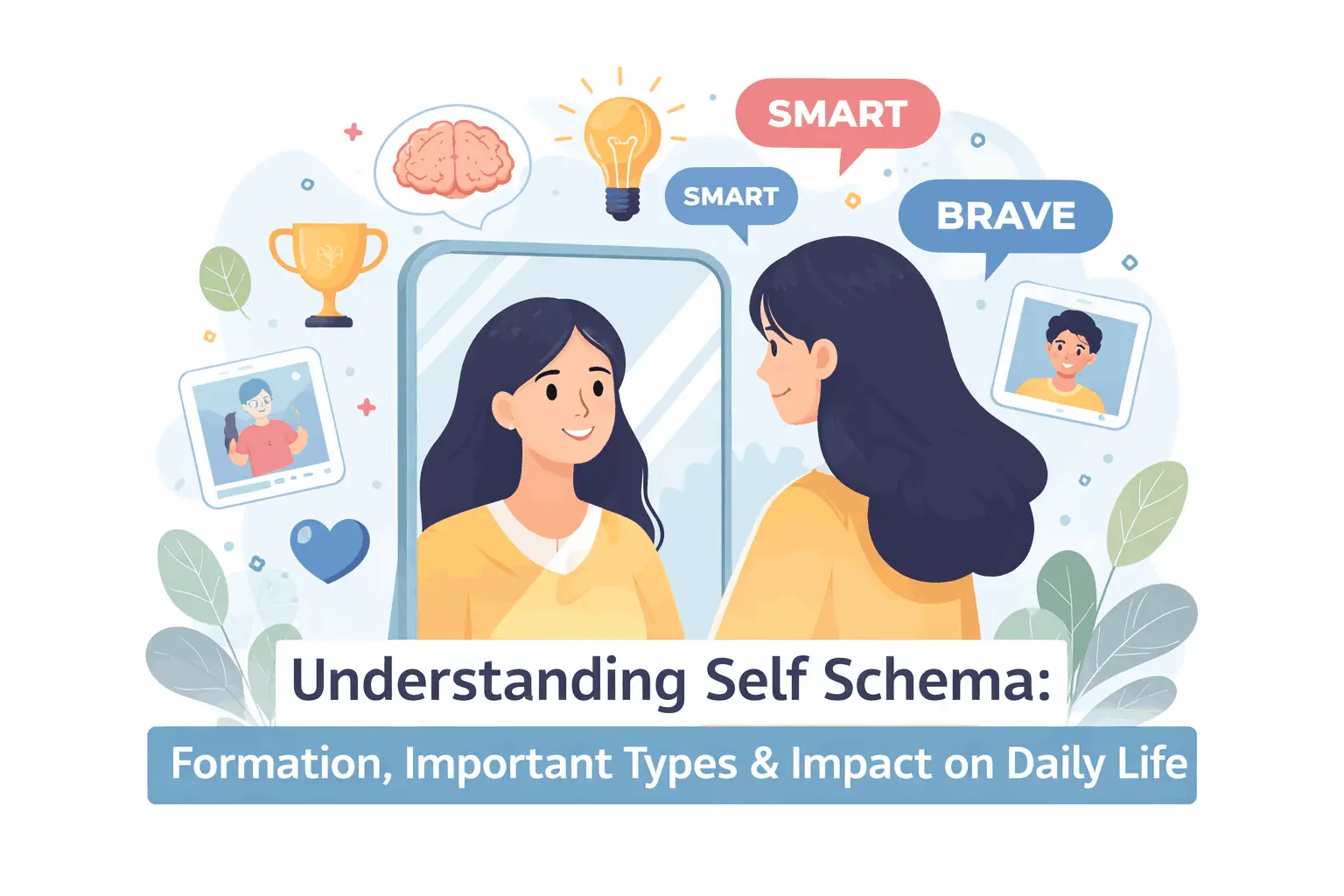
Understanding Self Schema: Formation, Important Types & Impact on Daily Life
Ever wonder how you see yourself, or why some thoughts about yourself come so easily? This mental map is known to psychologists as a self-schema.
Imagine it’s like a filing cabinet in your brain. There are folders there with words such as “capable,” “unlikable,” “athletic,” and “careless with money. These folders are created almost immediately for every new experience, and the filing system subtly influences how you understand what that experience means for you in the future.
What Does “Self Schema” Mean?
 In simple words, a self schema is a mental framework that stores a lot of information in our minds. Think of it this way: there is a cabinet in your mind. Inside this cabinet, there are folders with various labels. “Wise,” “Unlikable,” “Athlete,” “Responsible Individual,” “Careless with Money,” things like that. Whenever a new event occurs, we immediately file it into one of these folders.
The term was introduced by psychologist Hazel Markus in 1977, whose research showed that people are far from objective when it comes to themselves. if you believe “I am independent,” you are more likely to remember the events where you handled everything on your own. However, the occasions when you sought help from someone will simply slip from your memory.
Self schema determines which information about you gets through to you and which remains at the doorstep. That is why two individuals react completely differently when faced with the same criticism. One person simply ignores it. The other remains mentally distressed for days. The difference here lies not like the criticism itself, but in the “personal blueprint” upon which that criticism has an impact.
How Self Schema Forms
Self schema takes shape gradually, through everyday events and experiences almost always without conscious awareness.

Childhood feedback
Children accept anything they hear from others. When a child is continually told, “You are very smart,” this message becomes a part of his self-portrayal. In the same way, saying something such as, “You are very foolish” (even in jest) can create a self-perception that can last a lifetime. Many people, by the time they are in their teens, believe things about themselves that are not true, but have been repeated over and over and over again.Recurring experiences
A single unpleasant encounter does not prove a person is a “failure at relationships.” However, if five consecutive experiences are alike and all are interpreted from the same perspective they solidify into a fixed self-image. Repetition plays a fundamental role in this process. The brain naturally recognizes patterns; once it establishes a pattern regarding you, it no longer questions it.Social comparison
Social comparison is an important factor in the development of self-concept. We compare our characteristics with our siblings, our classmates, our colleagues and even people on social media. Although a confident sibling may be just a relative difference, it can become a fixed identity if a person is continually referred to as “quiet,” rather than confident.Family and cultural messages
Family and culture pass on specific mindsets to us.”We do not seek help.””It is difficult for people like us to acquire wealth.” These statements are not based on reality but are inherited self-conceptions. They are transmitted much like a traditional recipe one that is simply never questioned.
The Components of Self Schema

- Beliefs: In self schema belief yourself, like I am a student, I am very intelligent.
- Expectations for yourself: Expectations like how we will act and perform in different situations.
- Memories of past experience: the specific events that built and continue to reinforce your self-view.
- Self-perceptions:your sense of your own qualities, strengths, and weaknesses.
Types of Self schema:
A self schema is not a single, unified concept; rather, it is a collection of multiple self-conceptions that become active in various contexts.

Positive self schema: A positive self schema means you are very confident and positive about yourself. Your perspective of yourself and others is always positive and pleasant, such as being trustworthy or capable.
Negative self schema: A negative self schema means that you don’t fully appreciate yourself, always consider yourself a failure, look unattractive or a loser, and expect others to also perceive you as a failure.
Physical self schema: This includes concepts related to the body and physical appearance such as “athletic,” “heavy-set,” “tall,” or “plain.” These concepts significantly influence choices regarding clothing, the tendency to avoid mirrors, and decisions about participating in new activities, such as a dance class.
Social self schema: This includes the social self-concept how an individual presents themselves to others such as being “shy,” “funny,” “reserved in social gatherings,” or a “natural leader.” These perceptions influence the amount of conversation one engages in during meetings, the initiative taken to launch projects, and the assumptions made about whether others will like you, regardless of whether you have actually given them the chance to get to know you.
Achievement self schema: This concept is associated with ability/performance, “intelligent,” “bad at math,” “hardworking,” and “uncreative.” These perceptions are typically developed in the school years and applied in the workplace. Sometimes, they stem from a single grade or comment that continues to have an impact even years later.
Aschematic areas: It is worth noting that not every trait is linked to a strong self schema. If an individual is “aschematic” regarding a particular matter such as cooking then any opinion concerning it carries little emotional impact. If someone describes the food you have cooked as merely average, you simply brush it off; this is because your identity faces no threat, and there is no need for a defensive response.
Self Schema Across Life Stages
Self schema changes as you move through different stages of your life. The shaping of your self schema begins in your childhood.

- Early childhood: your self schema helps you process your experiences and who loves you.
- Teenage years: self schema helps you navigate social comparisons and form your identity as you adapt to changes in your social environments.
- Adulthood stage: self schema shapes your achievements, goals, and relationships.
- Later life: your self schema reminds you of life lessons and good and bad experiences, leading you to new growth.
How Self Schema Shapes Behavior
Self schema shapes the behaviour that tells us how we see the world. If you are capable, responsible, and confident in your behavior, even risking your copy is not difficult because you are confident in yourself. But if you consider yourself shy and immature, feeling like you can’t do anything, so you always try to stay behind, to the point where your self doesn’t even give you a chance. And then this thinking, your schema, shapes your behavior.
Self Schema and Mental Health

Whenever you think about anything related to yourself, surely negative thoughts come to your mind, judging yourself, considering yourself a failure. Due to such thoughts, your self schema starts forming a negative thought pattern, due to which you start getting anxious, stressed, or overthinking.
When your mind is disturbed all the time due to a negative self schema, then obviously, your mental health will also be disturbed. So, make sure you keep your self schema always positive and be confident in yourself.
How Self Schema Affects Daily Life
Your self-image is filled with these kinds of qualities, like being shy, not capable, and not responsible; it starts affecting your work, studies, relationships, social, professional, and even personal growth. Your daily life takes a hit as you start holding back, and it has a profound impact on your overall life.

In relationships
If a self schema has formed around the belief that “I am always abandoned,” the individual may involuntarily test their partner, withdraw from the relationship first, or interpret even neutral silence as rejection.
In professional life
If an individual holds a strong self-concept of “not being a leader,” they reject even those opportunities for which they are qualified. The sole reason for this is that leadership does not align with their personal narrative.
In health behaviors
An individual with a self-image of “I lack willpower” views even missing a single gym session as proof of that trait. In contrast, a person who sees themselves as “disciplined” regards it as a minor deviation and attaches little importance to it.
When receiving praise
It is easy for your heart to accept what others say if it is in line with your own perception of self: “Well done, that’s what you are.” If a compliment is given to you for a “leadership” action and you feel you were in the background, then you will say, “Oh no, it just happened by chance,” and dismiss the compliment.
Let’s look at a real-life scenario.
Consider the example of Sara not a specific real-life client, but a composite case study. Since childhood, her family had labeled her “sensitive,” usually with a sense of exasperation.
By adulthood, she had shaped her identity around this very label: avoiding conflict, assuming that criticism would destabilize her, and preemptively apologizing before even expressing herself.
Ironically, Sara was actually the most emotionally stable person in her circle of friends. However, a self-image does not change until reality contradicts it. Self-images are stubborn; they resist contradictory evidence rather than accepting it. Change occurred only when she consciously began keeping a record of instances where she handled criticism well. Consequently, her self-image gradually softened.
Related on Savvy Psyche
What the Research Actually Shows

The Role of Self Schemas in Going Beyond the Information Given
This study examined the impact of self schemas on the assessment of another individual’s traits, memory, and the making of predictions and inferences regarding that person.
In tasks requiring the use of information directly available about the target individual, no performance differences were found between “independent schematics” individuals who rate themselves highly in the relevant domain and “aschematics” those who do not rate themselves in this way. However, significant differences were observed in tasks requiring inference or extrapolation. This indicates that when a perceiver must go beyond the provided information, the self-concept systematically influences social perception.
Markus, H. (1977). Self schemata and information processing about the self. Journal of Personality and Social Psychology.
This is the foundational research that introduced the concept of “self schemas.” This work explains that self schema’s are mental structures that organize information about the self. They determine what we notice, remember, and infer about ourselves.
Academic Self Schemas and Their Self-Congruent Learning Patterns: Findings Verified with Culturally Different Samples
“I am good at math” vs. “I am bad at math” what is the impact?
This research involved two separate studies. The first examined Chinese high school students. When the data was categorized, two distinct groups emerged: those with a self-concept of “math is for me” (the positive group) and those with a self-concept of “math isn’t for me” (the negative group).
Their goals, study habits, and expectations differed vastly. The same test was then conducted with Australian students. Surprisingly, the exact same two groups emerged, and their learning patterns aligned perfectly with their self-concepts. This proved that the narrative you construct about yourself regarding math dictates how you learn it and this holds true regardless of culture.
How to Change Your Self Schema
Deciding to “think differently” rarely produces lasting change on its own. Since self schemas form through repetition, changing them generally requires the same mechanism in reverse.

Actively collect counter-evidence.
Keep a list on your mobile phone or in a diary. Whenever an event occurs that contradicts your belief”I am not that kind of person” note it down immediately. Your brain won’t do this on its own; you have to feed the evidence to it.Watch your language.
A statement like “I am anxious” solidifies a specific self-image. In contrast, saying “I am feeling anxious right now” leaves room for the feeling to be temporary and to pass.Notice selective memory.
If your memory is limited only to failures, honestly ask yourself what evidence you are overlooking.Adjust environments that reinforce the old label.
If certain relationships or places keep reinforcing an old label, visiting them less frequently weakens that hold.Test the belief on a small, safe scale.
If your self-perception is “I am weak at public speaking,” do not immediately choose a large forum. Start with a brief two-minute report during a team meeting.
Conclusion:
Your self-image is not your reality. It is a narrative constructed by the mind based on repeated experiences, some valid, yet many outdated. The good news is that narratives can be rewritten. Not through force or overnight but gradually, using the very same process by which they were formed: repetition, evidence, and attention. By paying close attention to where your self-image is quietly at work, you can decide whether it is still fit for the role.
Disclaimer:
All the information provided in Savvy Psyche’s articles is based on personal experience, exposure, and the study of mental health; if you are facing a serious mental health issue, please consult a licensed therapist.
Sources & Further Reading
Markus, H. (1977). "Self-Schemata and Processing Information About the Self." Journal of Personality and Social Psychology, 35(2), 63–78. Foundational paper introducing the concept of self-schema.
Catrambone, R., & Markus, H. (1987). "The Role of Self-Schemas in Going Beyond the Information Given." Social Cognition, 5(4), 349–368. Full text
"Academic Self-Schemas and Their Self-Congruent Learning Patterns: Findings Verified with Culturally Different Samples." Social Psychology of Education. Full text





2 Comments