
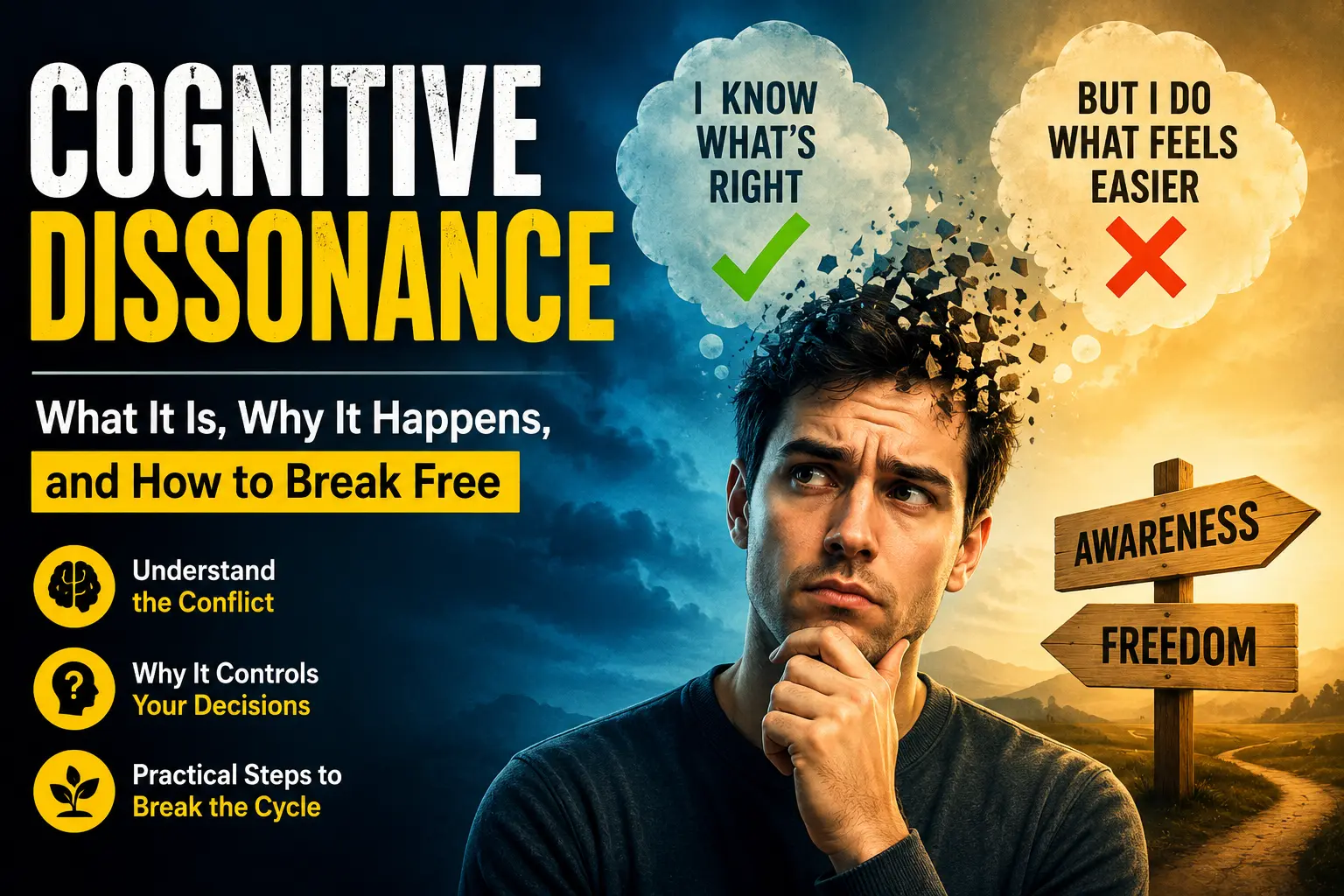
Cognitive Dissonance: What It Is, Why It Controls You, and How to Break Free
You know that junk food is not good for you, but you still consume it. Smoking is bad but another puff is needed. You know that it is a wrong relationship… but you remain in it. There is a gap between faith and action, and you should know what it is and how it can change your life.
We see ourselves doing a lot of hard and wrong things every day, but we seem to be doing them because we believe it is right. We have a very strong disconnect between our beliefs and our actions. Doesn’t that happen? All this is called cognitive dissonance.
In today’s Savvy Psyche article, we’ll break down cognitive dissonance with real-life examples, and most importantly, we’ll cover in detail how we can practically eliminate this mental discomfort from our lives.
What Is Cognitive Dissonance? (The Easy Version)
In 1957, American psychologist Leon Festinger proposed this theory.
when you have two thoughts inside your head. What you believe doesn’t match what you want to do, and this causes mental discomfort. This discomfort is called cognitive dissonance.
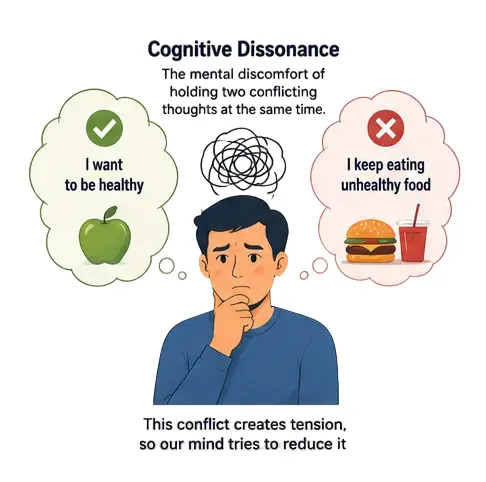
Festinger was saying that this discomfort isn’t inert. The brain works hard to solve it and change the behaviour is almost never the easiest way to solve it. The simplest is to explain the behaviour. To reframe it. To discover how it’s okay to do what you’re doing.
Real-Life Examples You Will Recognize
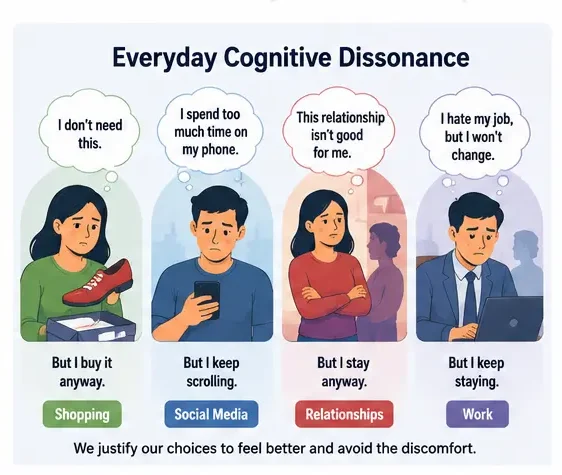
- You thought that today I will sleep early, I will wake up early and start my day, then a thought came to your mind that I will scroll my mobile for 5 minutes, you felt uneasy and a voice came in your mind that you are spoiling your routine, you should have slept early but at that very moment you thought that by scrolling for 5 minutes your mind will become fresh and you did that.
- You always tell your pals to be honest, but you told your friend you were unwell when he called to meet you, even though you weren’t. You realized that you were an honest person, so why did you lie?
The Psychology behind Cognitive Dissonance (Why your brain hates discomfort)
When two conflicting thoughts come to your mind, your mind feels mental discomfort, and you do not like that thing. Because our mind likes things based on logic or consistency, if some of his things are against his belief or material, then that person justifies it. Psychology says:
Your self-image is at risk
In cognitive dissonance, a person fears that they will become bad in their own eyes. A person feels good and honest when their beliefs and actions are the same, but when they are not, they make up for it by using facts and logic so that they don’t feel bad. If a person thinks that I am healthy, and I am a smoker, the person is wrong, and his/her self-esteem is taken a hit, so he/she does everything to save his/her self-esteem from being hurt and made bad, and make excuses.
Fear of judegment
According to psychology, people who fear being alone have more cognitive dissonance because they feel that people will judge them differently based on their beliefs. If their actions are contrary to those of others, then they will not get social acceptance. They accept others’ beliefs or actions as a trick and get social acceptance.
Decision-making problems
You make decisions with your mind several times every day. But if a decision goes against your beliefs, it creates a balance in your mind, which leads to conflict. And humans seek to resolve these conflicts quickly so as not to waste mental energy.
Why Cognitive Dissonance Forces You to Make Wrong Decisions.
Making incorrect decisions is not caused by cognitive dissonance; rather, it causes incorrect decisions to be proven correct. You’ve seen that you keep making poor choices, investing in questionable companies, staying in a hazardous work, and staying in a relationship that doesn’t fulfil you. Cognitive dissonance results from all of this. Let’s observe how this develops and how you are compelled to make poor choices.
- Cognitive dissonance becomes a barrier to your new thinking.
Anything that could be the cause of your failure, such as a fact or advice you find an excuse to ignore, is simply research-based. Every person’s perspective is different. Similarly, your cognitive dissonance blocks new thinking, and you justify that mistake and implement it.
Making the decision identifiable
Cognitive dissonance identifies you with planning, just as you need to be “in” every decision. In the same vein, when you make a poor decision, you feel as though you are incorrect since you are unable to substantiate it, so you choose to defend the poor choice rather than attempt to correct it.
Cognitive Dissonance Rewrites the Past
Cognitive dissonance alters your memory of past mistakes and errors, so that you initially consider your decision correct and fail to learn from past mistakes.
Cognitive dissonance leads to such further wrong decisions.
When you make a mistake, instead of correcting it, cognitive dissonance makes you make a worse decision. For example, working in a toxic workplace for 5 years was the worst decision of your life, but instead of defending it, cognitive dissonance makes you think that 5 years of your life will be wasted if you quit your job at this point.
Related on Savvy Psyche
A Personal Story: When I Justified a Bad Decision for 3 Months
After my entrance exam, I wanted to learn some practical skills in my free time. I read a post about an online course, its fee was 25,000 rupees, so I thought I would take it in my free time. Everyone said you are making a mistake, the fees are too high, and time will be wasted in commuting. You should learn this course online from YouTube. I did not feel good about proving myself wrong in my decision, so I insisted and went there to learn.
When I arrived I noticed that there was nothing new, all were old recorded lectures and everything was boring, then I thought of quitting it, but then, like cognitive dissonance, I felt that I would be proved wrong because of this decision, and my fees had also been deposited in advance, so all this would be wasted. So, I took my 3 months thinking about this decision, then I would at least get a certificate, At least it would look good on my CV.
I justified my decision, and 3 months passed. When 3 months passed, I realised that I did not learn this course, but saved myself from proving my decision wrong and deceived myself by defending my wrong decision, and this is cognitive dissonance.
Key Takeaways From My Journey.
When your mind or psyche refuses to admit you’re wrong, cognitive dissonance makes a thousand excuses to prove you right. We defend our judgement, not our own. So, the first step to overcoming cognitive dissonance is to teach yourself to say this sentence: “I am not mistaken, your decision is wrong, and I accept it.”
How Cognitive Dissonance Quietly Destroys Relationships
Cognitive dissonance wreaks havoc on our relationships, especially those that are long-term commitments.
Because the more time a relationship has gone on, the more invested in it is identity capital, and the more it is challenging to say that the relationship is a wrong.
3 Ways Cognitive Dissonance Trashes Your Relationships
Too many years have passed (The time trap)
When you’re stuck in a marriage that involves daily violence and have been married for several years, your mind keeps you trapped, thinking, “So many years have passed, now should I end the relationship, and people will say my decision was wrong.” This thinking prevents you from leaving a toxic relationship and from dismissing your own decision as wrong.They are not really bad minimizing the harm
Your friend teases you every time, they make fun of you, but you justify yourself by thinking that they are your very old friend and they are just joking and talking nonsense, or I am too sensitive for myself.I will change them the transformation illusion
When you choose the wrong person, you think that I will change him. Everything will become fine after marriage. Actually, everything is not fine; it does not occur to you that your choice turned out to be wrong, so you stay in that relationship and think that everything will change later.
We are unable to maintain every relationship out of love; we maintain it so that our old decisions do not prove wrong.
3 Major Research Discoveries About Cognitive Dissonance
2020 Harvard Business Review
This research was done on the business world. Those people who invest heavily in their failing business invest so much money because the CEO of that business does not accept the power; it is their fault. This is called Escalation of Commitment, and it is a direct symptom of Cognitive Dissonance.
2013 Study of Yale University
In this study, Yale University found that cognitive dissonance not only changes thinking but also alters a person’s memory. Research on the misinformation effect shows that when people are given wrong information after an event, many later misremember the event itself.
What Brain Scans Show
In this study, people were asked to defend their decisions while their brains were scanned with fMRI. When they were defending their wrong decision, that part of the brain was working in the scan. That part works when you get hurt, or your hand gets burnt, that part works when you feel pain, that is, when your brain sends you a message that you are wrong, you feel pain, and you cannot tolerate it. That is why we do not change the decision.
5 Common Mistakes When Dealing With Cognitive Dissonance
Admitting your mistake then immediately blaming the other person.
When you admit your mistake, but you make the other person feel that they were also mistaken, this divides the cognitive dissonance. In cognitive dissonance, you admit your mistake and put a full stop there, but do not get involved in proving the other person wrong.To go completely off track.
The sudden change from something you hated yesterday to something you love today can make dealing with cognitive dissonance difficult. A sudden change to eliminate your old pain can cause your mind to rush into something else to the extreme, leaving you without peace. Therefore, make changes in your life slowly, so that you feel comfortable.To remain silent out of embarrassment.
When you accept your mistake, you become silent after telling the truth or feel embarrassed. If you do not get the attention of people, it makes you think that speaking the truth in front of people will be embarrassing, hence you will not speak the truth anymore. Because of which cognitive dissonance becomes more dominant. So, whenever you tell the truth and accept your mistake, instead of feeling embarrassed, speak normally and answer people with a smile.Recognize your mistake and tell everyone immediately.
As soon as you admit your mistake, tell everyone about it, share a post online, and feel good about it. I have accepted my mistake, and I am feeling very good. By doing this, you want people’s praise and appreciation more than you want your mistake to be accepted. And there will be no change in your inner self or behavior, which is of no benefit.Deciding you are stupid or worthless for having the dissonance
When you realize that you are mistaken, now your own thinking of yourself as wrong or calling you stupid makes you feel painful, due to which cognitive dissonance tells you that you are not stupid, your decision was right, due to which your wrong decision becomes stronger. So, whenever you feel bad or stupid, your mind thinks that you are not stupid or your decision was a little wrong, due to which you feel guilty.
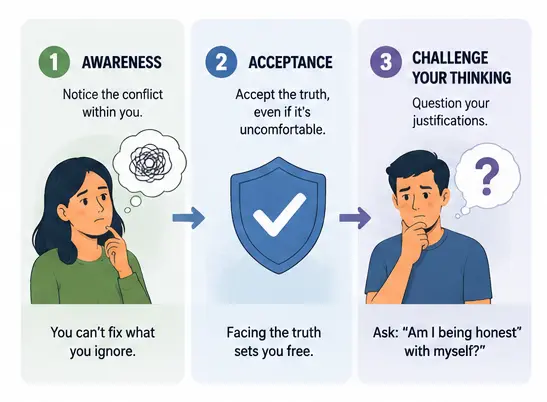
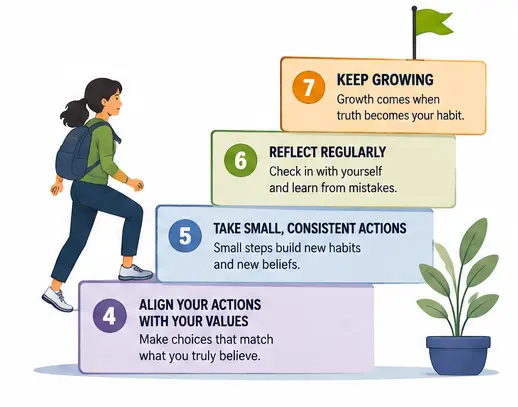
7 Practical Steps to Actually Overcome Cognitive Dissonance
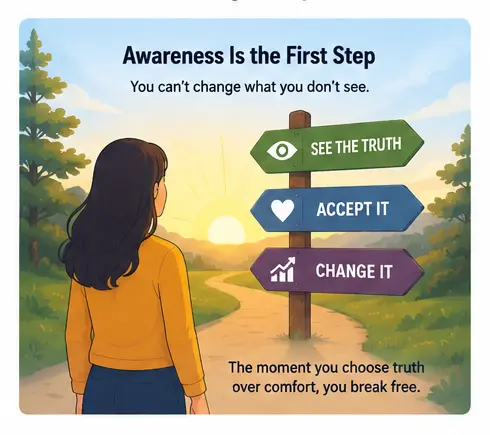
Accept being wrong and make a habit of it.
Cognitive dissonance can’t be eliminated until you’re ready to get rid of your own mistakes and your own pride. Therefore, accept your mistakes and make the habit of taking responsibility for your mistakes. Mistakes are not weaknesses; it means that you are trying to improve yourself.When you yourself don’t understand, look to others
When you are unable to understand your own decision, seek the opinion of a neutral person who has no harm or benefit from your work.Small loss, big gain
It’s better to save up front than to waste three months trying to save 25,000. Even a penny stuck in a bad decision is worth saving.
Write your proofs
Write your old beliefs and your new beliefs in any diary or page with written proof. And know what changes have happened in your old proof. By writing your mind in your honest reply.Do not react in haste
Don’t react immediately to something that challenges your viewpoint. Think about it for a day and then act. Cognitive dissonance forces you to react quickly, but to pause and act on it. This weakens the thought process.Separated the decision from the “I”.
Whenever your own judgement proves you wrong in every decision, you will feel pain, and cognitive dissonance will prove your decision right. So, look at yourself in the mirror and say, I was not mistaken, my decision was wrong, I was not foolish, my choice was wrong.Forgive yourself for your past actions
We tend to think badly of ourselves because of our past mistakes, so it’s important that we forgive ourselves for our past mistakes. But let’s just say we gave our best in the past, but now we’ll try our best again. Forgiving ourselves gives us a sense of safety, and it’s easier to accept the truth.
When do you seek professional help?
When you feel like your problem isn’t showing any improvement even after taking these practical steps, you should seek help from a licensed therapist. Seeking help from someone shows your strength, not weakness, and a therapist will deal with this issue professionally and help you overcome this problem.
Conclusion:
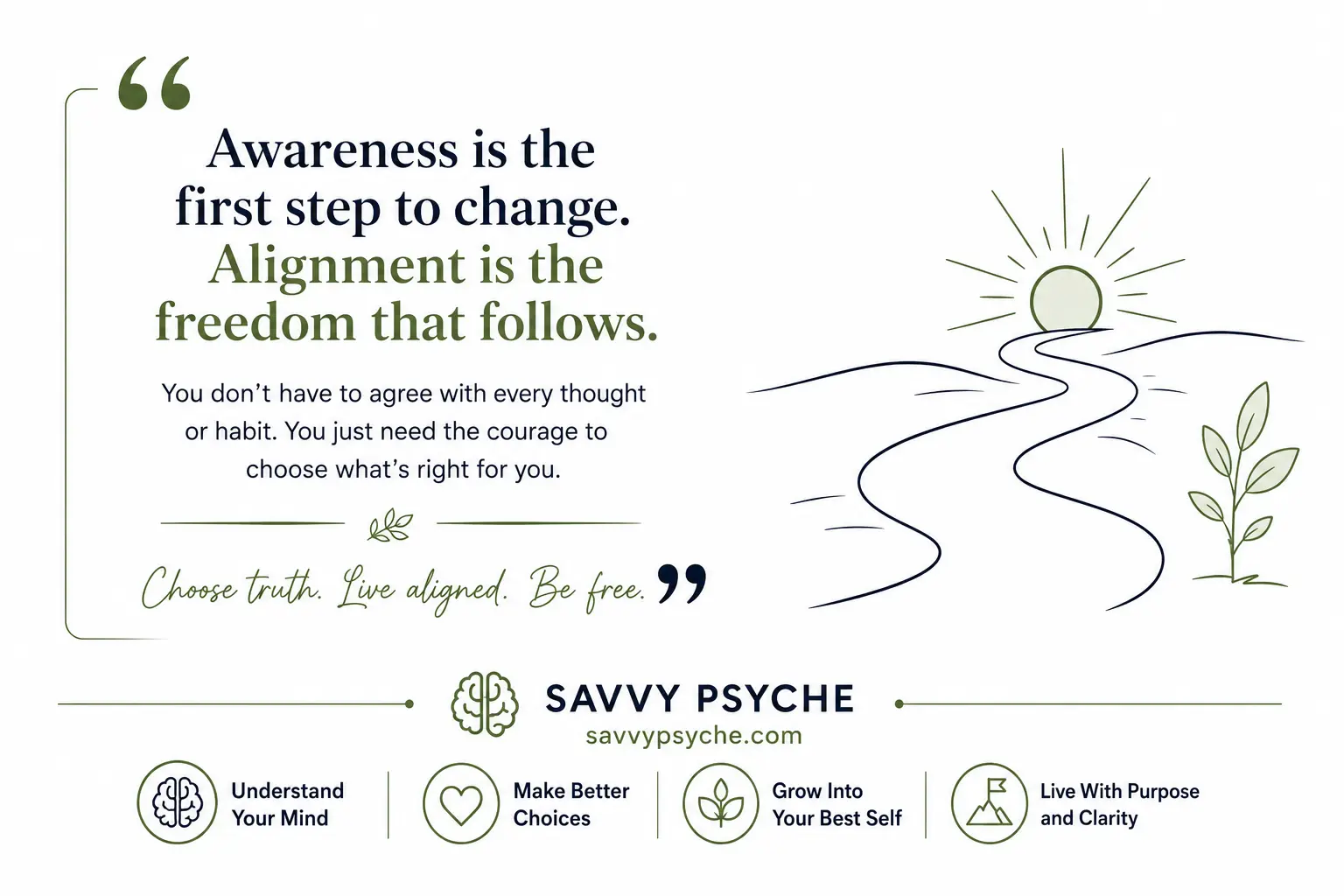
Speaking the truth is not a weakness but a freedom of the mind. Cognitive dissonance is our underlying fear. We all have a slight fear of the truth because cognitive dissonance distances us from the truth, because we feel pain when we are mistaken, and this distances us from that pain and does not make us accept the truth.
Reminder:
No one is wronged by admitting a mistake. The wrong person is the one who makes excuses despite the truth. By deciding today, you will free yourself from the trap of excuses, speak the truth, and find peace in your life.
Disclaimer:
All the information provided in this Savvy Psyche article is based on personal experience and mental health research. If you have a serious mental health problem, consult a licensed professional therapist.
Sources & Further Reading
-
Festinger, L. (1957). A Theory of Cognitive Dissonance. Stanford University Press. Psychology Today overview
-
Harvard Business Review (2021). How Susceptible Are You to the Sunk Cost Fallacy? (David Ronayne). View articleWesten, D., et al. (2006). Neural bases of motivated reasoning: an fMRI study of emotional constraints on partisan political judgment. Journal of Cognitive Neuroscience (Stanford-affiliated research). View study
-
APA: Cognitive approaches to belief and behavior
-
Psychology Today: Cognitive dissonance research and overview


One Comment