
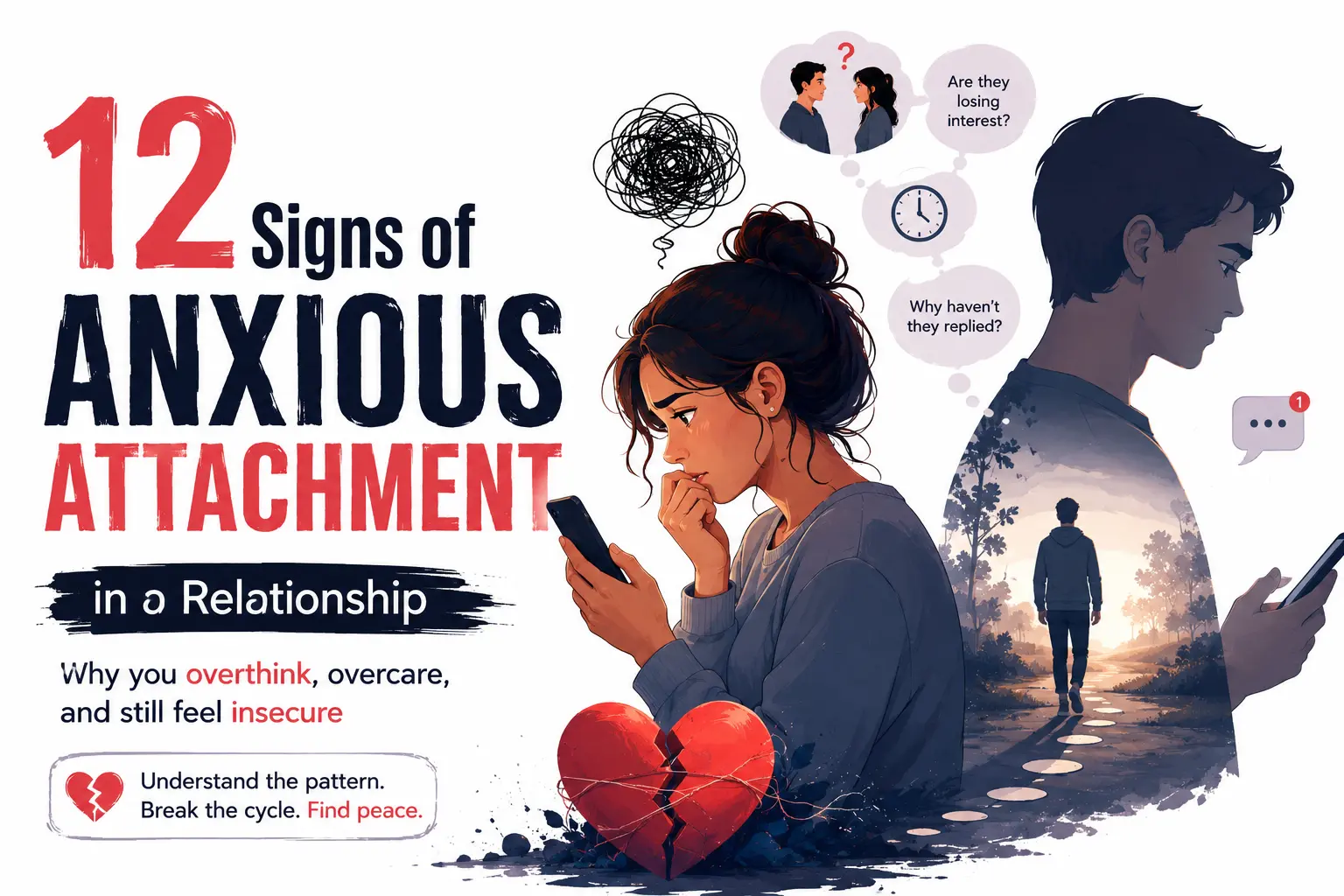
12 Signs of Anxious Attachment in a Relationship
Your phone is in your hand. It’s been an hour since they replied. In that hour, your mind has already run through a hundred different scenarios, replaying the last conversation word for word, feeling the panic rise, fighting the urge to send one more message just to hear “I’m here, we’re okay.”
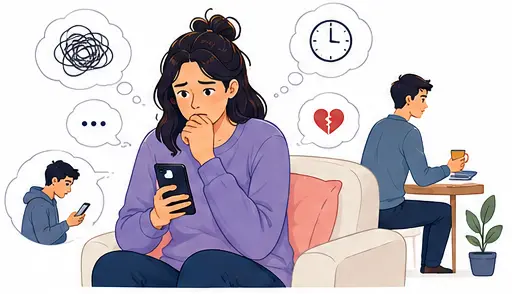
If your heart said, “Yes, this is my story. Now take a deep breath. “You are not alone. This is a natural reaction at times. If it becomes a regular occurrence and makes you tired in the evening, it is an indicator of anxious attachment and is not a reason to think that there is something wrong with you, that you are “too much. No. It’s just something we were taught when we were young that is causing problems now. Yet, there is hope. There is plenty of hope. Because this can change. By understanding yourself and making small shifts in your habits, you, too, can find a love that brings peace.
Here, you will learn what anxious attachment looks like in a relationship. You will discover the reasons behind it. And you will also find some simple ways to start breaking this cycle.
What Is Anxious Attachment?
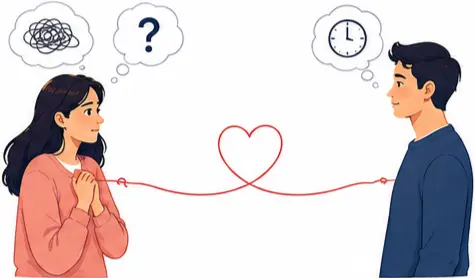
Imagine a heart deeply restless for love, craving companionship, conversation, and reassurance. This is what anxious attachment looks like; such individuals seek depth and connection in a relationship. Yet, a silent fear constantly lingers within them: “What if it all comes to an end?” “What if I am left behind?”
Instead of resting in the relationship, the mind stays occupied: do they still love me? Are they pulling away? Did I upset them? Strangely, the other person often hasn’t done anything wrong the fear feels real regardless. This isn’t clinginess. It reflects something learned early: to stay safe, catch the danger early. A delayed reply can feel like a storm. “I want some time alone today” can register as a threat. There’s no actual danger present just a heart that’s learned to stay on high alert.
Why Does Anxious Attachment Develop?
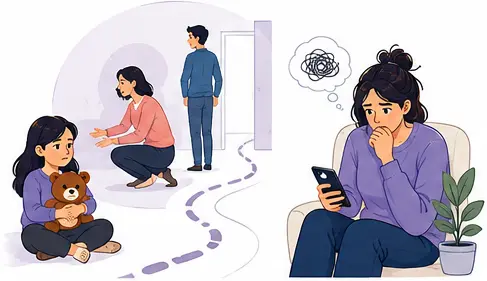
The roots are formed in childhood. If a child is assured of their parents’ presence and love, they grow up with a sense of security. But if that love is inconsistent. Sometimes close, sometimes distant. A child learns that “maintaining a relationship requires constant vigilance.” Consequently, even as adults, we remain hyper-aware of the “state” of every relationship.Underlying this is a single fear: “What if it ends?” This habit persists into adulthood, often without us even realizing it. And it isn’t solely due to childhood experiences. Wounds sustained in adulthood deepen this tendency further, such as a painful breakup, betrayal, being left emotionally isolated, or a relationship that hollows you out from within.
Keep this in mind: This is not a flaw of yours. It is a survival mechanism taught by circumstances. And what can be learned can also be changed.
If you recognise this pattern in yourself, it can help to understand why you get attached so easily.
12 Signs of Anxious Attachment in a Relationship
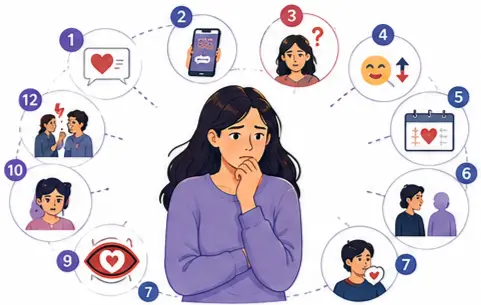
Not everyone exhibits every sign. You might notice some of them, or quite a few. Just understand that this is normal.
Constantly seeking reassurance
Is a major sign of an anxious attachment style; you frequently need reassurance about the relationship. The problem is that even after receiving an answer, the sense of calm is only temporary. Those same thoughts soon return.
Example:
Your partner says “I love you” while leaving the house. Two hours pass without a reply to your message. The thought immediately crosses your mind: “Maybe they are angry. Maybe they aren’t interested anymore.” Nothing had actually happened, yet you sent another message.
Overanalyzing every message
If the difference between “Okay” and “Okay” can make or break your day, that is a sign. People with anxious attachment styles are highly sensitive to even minor shifts in a conversation. They spend hours wondering:
- Why was the reply so short?
- Why haven’t they opened the message yet?
- Why did they read it but not reply?
- Why does the conversation feel strange today?
Everyone wonders about these things occasionally. But here, every interaction turns into a mental interrogation.
Fear of being left alone
Lies at the root of anxious attachment. Even in a good relationship, a lingering fear remains in a corner of the heart: “One day, they will leave.” Because of this, you:
- Avoid discussing important matters
- Hide your true feelings
- Put your own needs aside
- Cling to relationships that aren’t right for you
The irony is that in trying to save the relationship, we often end up making it difficult.
Mood tied directly to a partner’s behavior
You can have a fantastic day when you get a loving message, and a terrible day when you don’t get a reply right on time. If you have an anxious attachment style, then the level of peace and happiness you feel is directly linked to “how close we are today. It is an emotional roller coaster; your sense of security is dependent on another person and changing hourly. Healthy relationships are those in which you don’t need to rely on the other person alone to keep you safe.Difficulty with time apart
All healthy relationships need to have both togetherness and separation, but for an anxious attachment style, separation (whether it is physical or emotional) is very uncomfortable.
Sometimes, you may suffer from:- Feelings of loneliness after just a few hours
- Anxiety about meeting your partner’s friends
- Unease if there is no “check-in”
- The desire to stay close is not a bad thing.
The challenge arises when separation feels like rejection rather than simply a normal part of life.
Consistently prioritizing the partner over yourself
Those with anxious attachment often strive to keep everyone happy. They think, “If I am good, they won’t leave me.” This manifests in ways such as:
- Agreeing to things against one’s own wishes
- Avoiding disagreement
- Ignoring personal boundaries
- Constantly trying to please the partner
This is a sacrifice at first. However, later it causes dissatisfaction and exhaustion, and you forget about your needs. You must feel free to be yourself in a healthy relationship.
Jumping to negative conclusions
With an anxious attachment style, the mind is quick to concoct scenarios. If a partner speaks less, cancels a meeting, or is slow to reply, one’s heart immediately feels like “everything is ruined.” Thoughts like these begin to race through the mind:
- They are losing interest.
- It must be my fault.
- They are going to leave me.
- Maybe they’ve found someone else.
In reality, however, they were simply busy with work, exhausted, or dealing with another issue, none of which had anything to do with the relationship.
Frequent, intense jealousy
Jealousy is a natural emotion, but when coupled with an anxious attachment style, it arises more often and feels far more intense. You begin to compare yourself:
- To their ex-partners
- To their friends or colleagues
- To people they interact with on Instagram or Facebook
This does not imply that you feel that your man or woman is doing something wrong. In most cases, it’s a lack of the belief, “I am enough.” This fear can escalate even minor issues to be a big threat. Where your question changes: You used to ask, “Are they faithful?” but you now ask, “Am I worthy of them?
Losing your own identity in the relationship
Out of fear of losing someone, we often lose ourselves. You start to think about your partner without even realizing it. Or maybe you’re not seeing your friends as much. Maybe you’re no longer interested in your hobbies. Maybe you think about it when making every choice you make: “Will this hurt the relationship? A good relationship is not who you are; it’s just part of your life. Maintaining friendships, objectives, and hobbies. You’re better for it, as is the relationship.Treating conflict as a threat to the relationship’s existence
In every healthy relationship, there will be some conflict. However, to an anxious attachment, even a smaller disagreement can be scary. Is not treated as a ‘problem to be solved’; it is seen as an end to the relationship. These are some of the behaviors you may be familiar with:
- Apologizing immediately, even when not at fault
- Feeling panicked during an argument
- Begging the other person not to leave
- Rushing to fix everything quickly
One thing that healthy couples know is that disagreement does not mean danger. The first step to secure attachment is to identify the difference.
Constantly checking for signs of affection
With anxious attachment, even minor shifts in affection can feel magnified, leading you to ask yourself questions like:
- Did they hug me differently today?
- Why didn’t they say ‘I love you’ before bed?
- Why didn’t they ‘like’ my post?
- Why are they so distracted tonight?
When the mind craves reassurance, even ordinary interactions can appear as warning signs. This constant emotional scanning becomes exhausting for both partners.
Reassurance that works like medicine briefly
It eases pain but briefly. Their heart is at ease with the word “I love you”. However, an hour later there is a question: “Will they say the same tomorrow?” And the cycle begins:
Fear → Reassurance → Brief relief → Fear again.
External support is only temporary, since the cause of the problem is internal. With the learning of trust in yourself, lasting peace occurs, not relying on the relationship alone.
What Happens When Anxious Attachment Enters a Relationship
Anxious attachment does not mean the relationship is ruined. Many couples build happy, strong relationships despite attachment issues. However, there is one condition: do not ignore it. If we do not work on it, it can create patterns that leave both partners emotionally exhausted.
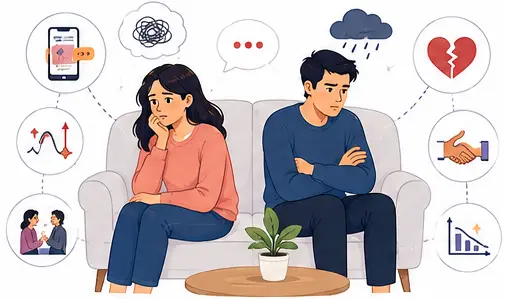
Anxious attachment affects relationships in the following ways:
- Misunderstandings become common
- Constant reassurance is needed
- Moods fluctuate hourly
- Trusting feels difficult
- Arguments increase
- Excessive dependence on one another
- Ultimately, both partners become emotionally drained
The greatest victory is simply realizing it. Awareness is the beginning of healing. When you give a name to these patterns, you are no longer a slave to automatic reactions. You respond by choice, and that is where everything changes.
When that dependence starts to run the relationship, it is worth reading about emotional dependence.
Is It Love, or Is It Anxious Attachment?
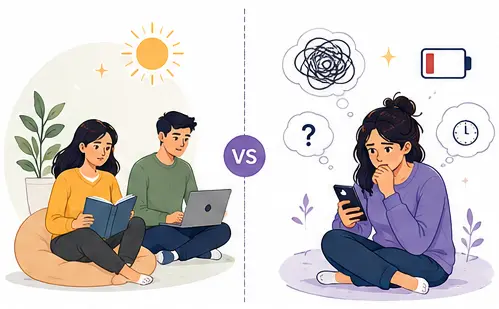
The truth is, sometimes anxiety is so intense that it feels like love, like passion. But it isn’t. Healthy love is like home; it brings peace. It is a place where the heart knows, “I am safe.” But anxious attachment? That is like a storm: constant fear, constant wondering, “What will happen?” Love is built on trust; anxiety, on doubt.
Ask yourself:

Is there peace even when apart?

Do you enjoy your own life, too?

Is there trust without the need to prove it?

Even after a disagreement, am I confident that we will be okay?
If nearly all your energy goes toward fear of losing someone, with little left to actually enjoy the relationship, that’s the anxiety speaking not a verdict on your worth, but a wound worth understanding and healing.
What the Research Actually Shows
Romantic Love Conceptualized as an Attachment Process
This research suggests that love is a form of attachment. Just as a child clings to their mother, adults also desire to cling to their partners. This concept is the result of years of work by Bowlby and Ainsworth, who identified three distinct attachment styles in children.
Researchers subsequently tested this on adults using two questionnaires. The findings showed that adults have the same three types of people, and that their attitude to love, their self-image, and even their relationship with their parents are all correlated. We are, in a way, our past.
Anxious and avoidant attachment affect romantic relationship quality differently: A meta-analytic review
This was a meta-analysis from 2012 and a meta-analysis is basically the “sum of all research.” It included 73 different studies, with 21,602 participants in total; just think about how big that data set is.What were the findings? Both anxiety and avoidance act as poison for a relationship. However, there was a distinction: Individuals with an avoidant style experience the least sense of comfort, intimacy, and support within the relationship.
In contrast, relationships involving anxious individuals are characterized by the highest levels of conflict and arguing. The most interesting part? There was no discernible difference based on gender. However, self-reported data and external observations differed. An insecure connection undoubtedly lowers a relationship’s quality in every way.
Related on Savvy Psyche
Codependency: Signs, Root Causes, and How to Break the Pattern
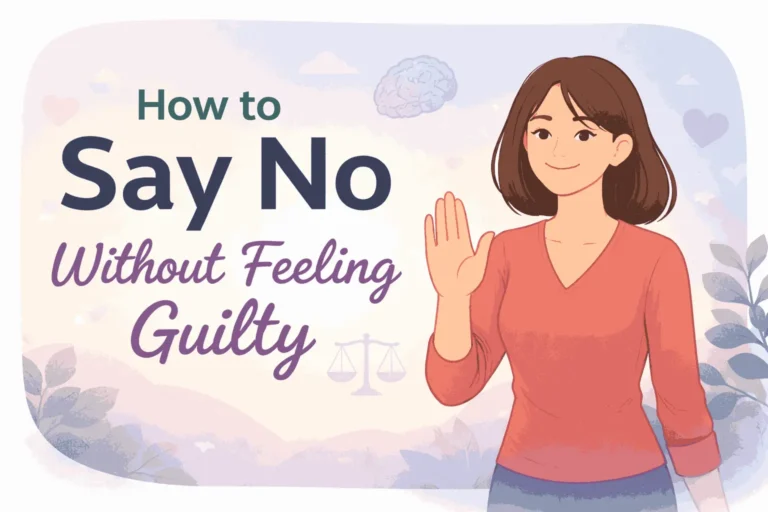
How to Say No Without Feeling Guilty: 7 Simple helpful strategies
How to Heal Anxious Attachment
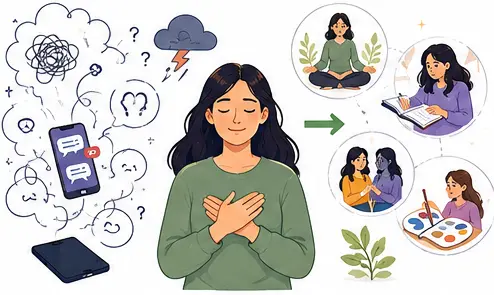
Notice when your heart feels anxious
Often, we focus on the impact of the pain rather than its root cause. First, identify the cause. Look in the mirror and ask yourself:
- Does waiting for a reply make me restless?
- Does the thought that “they are happy without me” bring me to tears?
- Does a moment of estrangement make me feel like “it’s all over”?
These are all signs of your emotional triggers. So, make a promise: next time your heart feels anxious, you won’t rush to send a message. Instead, pause and ask your heart:”Is this actually happening, or am I thinking this way out of fear?” Believe me, this simple question will save you from immense distress.
Interrupt the mental movie
Do you know what an anxious mind does? If a single message doesn’t arrive, it spins an entire narrative. “He’s going to leave me”, thinking things like:”It’s been three hours; he must be bored by now, maybe he’s with someone else.” Stop right there. Ask yourself gently:
- Do I have any concrete proof?
- Could it be that he’s driving? Or in a meeting?
- Has he ever made me feel this way before?
Look, most fears are just fears, not reality. Listening to your heart is good, but there is no need to cause yourself pain by accepting every fear as the truth.
Reconnect with your own life
Have you ever wondered how long it has been since you last laughed? That laughter which was solely for you, not triggered by someone’s reply? Ask your heart:
- What was that hobby I used to spend hours on?
- Which friend’s voice haven’t I heard in ages?
- What dream did I put off for “later”?
When our entire world revolves around a single person, their absence makes our world seem dark. Bring the light back into your life. Meet friends. Learn something new. Dedicate time to yourself because a beautiful relationship is one where two people are together, yet both retain their own distinct identities.
Steady yourself before reaching out
Sometimes we ask, “Is everything okay?” simply because our hearts are pounding. There is nothing wrong with that. But if we constantly seek solace from others, we will eventually grow weary. So, the next time you feel anxious, put down your phone and tell yourself, “I am okay.” Then, try this, a remedy for yourself:
- Breath: Slow, long, and deep.
- Steps: Step outside and look at the sky.
- Paper: Write down whatever is in your heart.
- Sound: Listen to something soothing.
- Moment: Look around you notice 5 things, 4 sensations, and 3 sounds.
Often, nothing is actually wrong with our relationships; it is simply that a storm is raging within us. And that is a storm we can calm ourselves.
Express needs calmly, without blame
Anxious individuals often remain silent, only to eventually explode. “You never reply to my messages!” This damages the relationship. Instead, address the issue early on, but without assigning blame.
The wrong approach:
"You never make time for me!"
 The right approach:

I have been reading that I get anxious when I don't hear from you for an extended period. Well, I know you're busy, but if you can send a quick message, it will make me feel better.
See the difference? Here, you shared your feelings rather than blaming your partner. This helps to start a positive conversation rather than an argument. Keep in mind, the purpose of healthy communication is not conflict; it’s understanding.
Practice sitting with uncertainty
We want life to give us a written guarantee that “everything will be fine.” But it’s not the way life works, and that’s what we have to learn. We must learn to sit in uncertainty and not panic. It’s not necessary to endure daily or hourly comments like “you’re loved. In love, there is no silence; love is expressed in the little things. When your heart thinks/feels worried, try to relax and say to it, “I’m okay. I need not know it all now. I can do this! The more you say this, the less the fear voice will be.
Fear → Reassurance → Brief relief → Fear again until the pattern is addressed at its root.
When to Seek Professional Help
If these patterns are deeply ingrained and it feels like everything is spiraling out of control, then stop. This is not an alarm; it is a signal. A signal that the wound is deep, and deep wounds cannot be healed in isolation. Here is what a licensed therapist will do for you:
- The roots of the matter: finding out how it got there.
- Providing you with new tools: New strategies for coping with anxiety.
- Emotional Control: Keeping a cool head in a hot moment.
- Self-worth: Develop a sense of self-worth.
- Secure habits, Finding peace and stability in relationships.
Taking treatment is not a “weak” thing to do. It does take a lot of courage, it does say, “I want a better life. It’s an investment in your relationships and in your own peace of mind.
Bottom line:
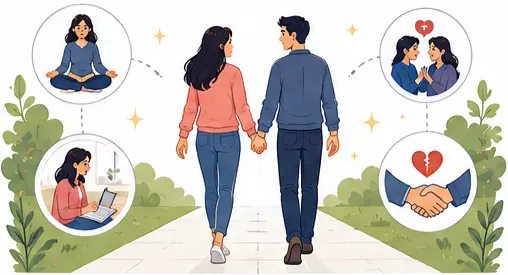
Healing doesn’t mean “never feeling insecure again.” Healing means those storms will occur less frequently. When they do come, they will be less intense, and you will have the tools to deal with them. You will start to believe more in yourself. You ask questions instead of making assumptions.
You take a breath instead of sending a message in a panic. Most importantly, you will discover that you are not worthless because they did not follow you or tell you, ‘I love you’. It’s not about being 100% sure in relationships. They are founded on trust, open communication, respect, and learning together. This will not happen in a hurry. But it will happen. One step. Then another. You can do it.
Disclaimer:
All the information provided in Savvy Psyche’s articles is based on personal experience, exposure, and the study of mental health; if you are facing a serious mental health issue, please consult a licensed therapist.
Sources & Further Reading
-
Hazan, C., & Shaver, P. (1987). "Romantic Love Conceptualized as an Attachment Process." Journal of Personality and Social Psychology, 52(3), 511–524.Full Text.
-
Li, T., & Chan, D. K-S. (2012). "How Anxious and Avoidant Attachment Affect Romantic Relationship Quality Differently: A Meta-Analytic Review." European Journal of Social Psychology, 42(4), 406–419. Abstrac

5 Comments