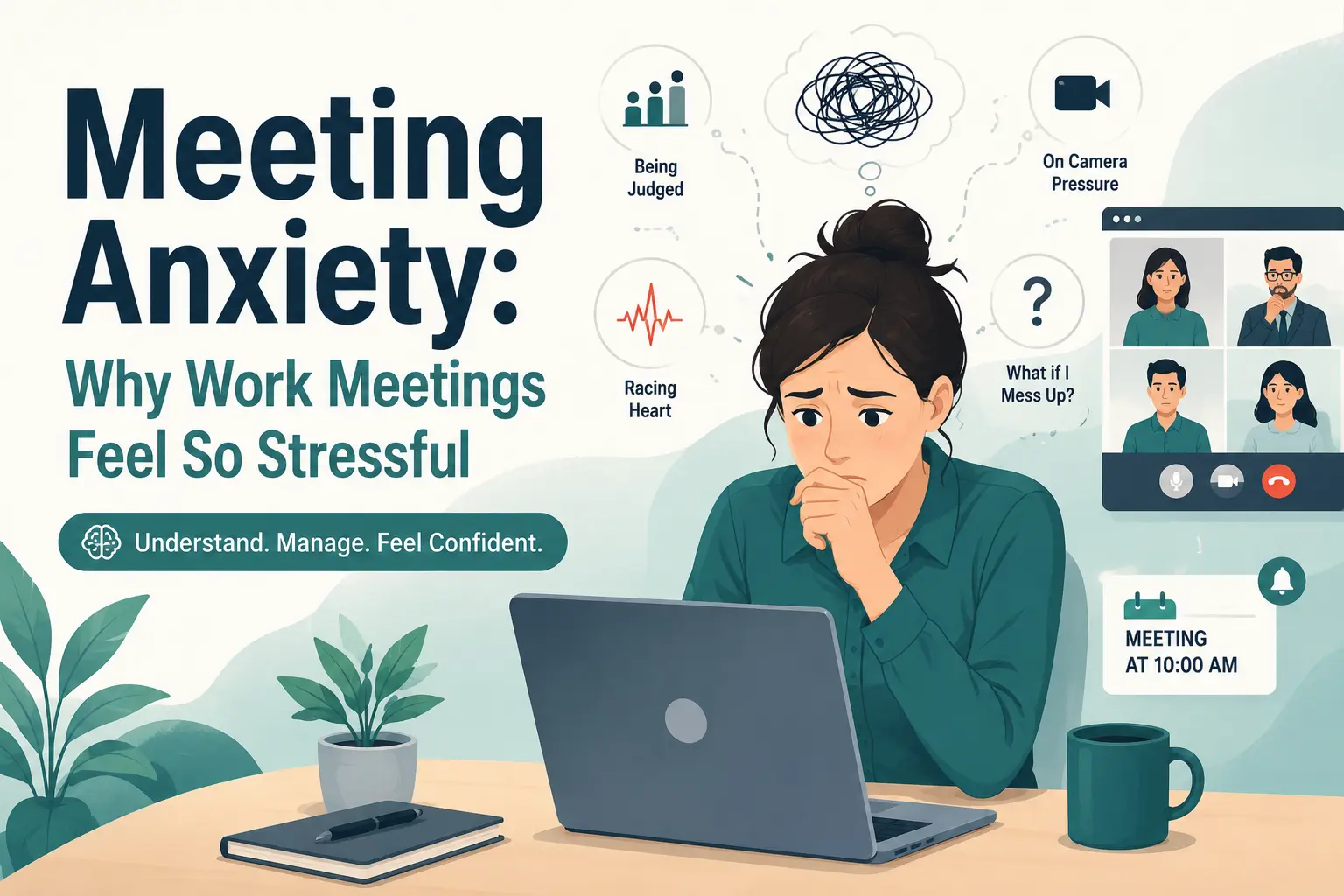
Meeting Anxiety: Why Work Meetings Feel So Stressful
Meeting anxiety can make even a routine work meeting feel surprisingly stressful. 9:47. The meeting will be at 10. Know the agenda and have a line that you may never actually say verbatim. Your heart is already racing, and it’s not the task itself that gives you the terror. It’s a matter of surveillance.
Anxious about all meetups, including the 15-minute stand-up on Tuesday? You’ve probably said to yourself at night, “I’m just weak. The simple fact is that there is no problem with you. It’s an all-too-familiar response to the nature of modern work, and there’s real science in why meetings cause this reaction.
It’s Not Just You
80%of remote and hybrid workers report feeling anxious about online work meetings specificallyThat number alone is worth sitting with. You’re not flawed, and you’re not the problem. Meetings themselves create a genuinely demanding environment, and your body and mind are doing exactly what they’re supposed to: recognizing a perceived threat and responding to it.
Why Does Meeting Anxiety Happen at Work?
Not all anxiety is the same. The anxiety associated with a meeting has a nature of its own. It has its own specific cause.
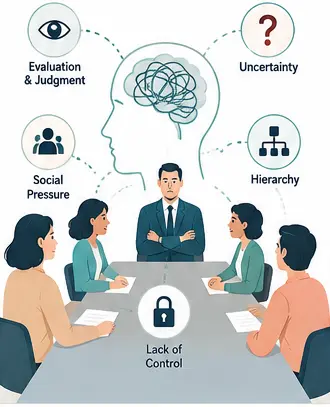
You’re being evaluated
Meetings aren’t just about work; they are also an assessment. Your boss, your colleagues, and sometimes even senior figures everyone is watching silently. Every word you speak feels like something that will be noted for later. How can your body relax when, at every moment, you feel you are being scrutinized? That is why even a brief meeting can feel suffocating.
Scrutiny plus uncertainty
Being under scrutiny and the uncertainty of what might happen. Both factors are present in a meeting: you are unprepared, yet everyone is watching you. It is the perfect recipe for anxiety. That is why the advice to “stay calm” feels useless. It really comes down to a name.
Who’s in the room
The moment a manager or a senior figure joins in, your heart starts racing. The issue isn’t the presentation itself. The real issue is who is sitting across from you and what they will think of you.
Zoom fatigue

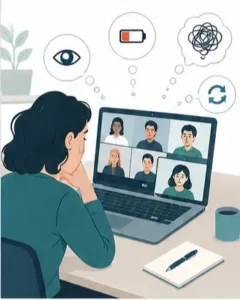
You are speaking while simultaneously staring at your own face in a small window: Do I look weird? Are there clothes lying in the background? Is my posture straight? You have to talk, listen, and monitor yourself all at once; it is mentally exhausting. People call this exhaustion “Zoom fatigue.” So, it is only natural to feel a sense of dread at the thought of a video call, isn’t it?
Imposter syndrome and perfectionism
The two often go hand in hand, and meetings provide the perfect setting for this; if you harbor a suspicion that you aren’t as capable as others believe, a meeting becomes a stage where that fear can manifest. A meeting becomes an occasion where this fear risks being exposed to everyone. Perfectionism further exacerbates this; any question answered imperfectly continues to replay in your mind for hours afterward.
Anticipatory anxiety
That is why the heart starts racing at night, or the moment a meeting notification pops up, the mind immediately starts playing out scenarios: “What if they ask this and I can’t answer? What will everyone think?” And the strange thing is, the body reacts to this thought as if it were actually happening. This is what is known as the “Sunday scaries” fear arising before the problem has even occurred.
Physical and Mental Symptoms of Meeting Anxiety
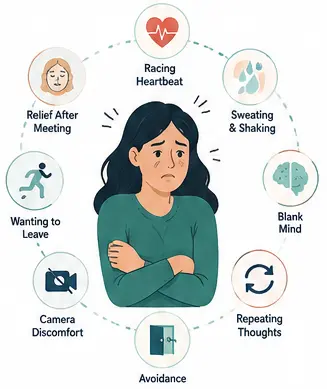
If you suffer from meeting anxiety, look out for these symptoms:
- Chest tightness or rapid heartbeat beforehand.
- Sweating, shaking, or wanting to leave the room.
- Once yours is up, you can’t think of anything to say.
- Repeating yourself over and over again for the rest of the meeting and feeling bad about it, even if nobody else noticed.
- A reluctance to attend meetings or to use the camera.
- Failing to make it through the meeting and feeling at the end of the day very relieved when the meeting is over, regardless of the outcome.
If several of these are familiar, this isn’t an exaggeration or a personality quirk, it’s a recognized pattern of workplace anxiety.
Is It Normal Nervousness or Meeting Anxiety?
You have to be honest with yourself; don’t rush to apply labels. First, understand the difference. Normal nervousness is like a guest. It makes a racket when a big meeting is coming up, but stays quiet for a small one. And it leaves as soon as the meeting begins. Yes, it feels unpleasant. But it doesn’t consume your entire day.
When this anxiety deepens, it ceases to be merely about a meeting. There is nervousness before every encounter. You keep your gaze lowered; even when you have something to say, you remain silent. Because a single voice echoes within: “What if I come across the wrong way?” Gradually, this fear begins to dictate the decisions you make in life. You hold yourself back. You ask for neither a project nor a promotion. Simply to avoid being noticed.
Research on workplace anxiety reveals exactly this pattern; it is not a matter of simply “toughing it out.” If these points resonate with your own experience, it is better to speak with a therapist rather than enduring it by dismissing it as merely a part of your “personality.”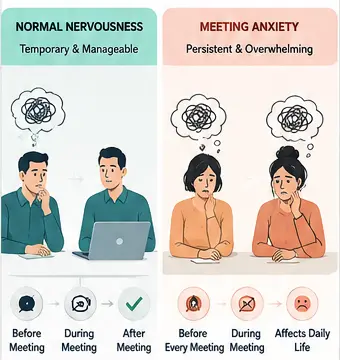
Related on Savvy Psyche
How to Smartly Spot and Handle Passive Aggressive Behavior at Work
People Pleasing at Work: Why It Backfires and How to Finally Stop
What the Science Says
Research on meeting anxiety points to two primary drivers: feeling under scrutiny, and a psychological safety gap, the absence of a felt sense that “I won’t be judged here.” The concept of psychological safety, developed by Harvard Business School’s Amy Edmondson, describes exactly this: a shared belief within a team that it’s safe to take interpersonal risks, like admitting a mistake or asking a question, without fear of punishment or humiliation.
The genuinely useful finding here: meeting confidence tracks more closely with preparation and psychological safety than with seniority or expertise. When people have some real control over how a meeting runs clear structure, defined roles, adequate time to prepare anxiety measurably decreases, because a sense of control is one of the most reliable levers for reducing anxiety in general.
What Actually Helps With Meeting Anxiety?
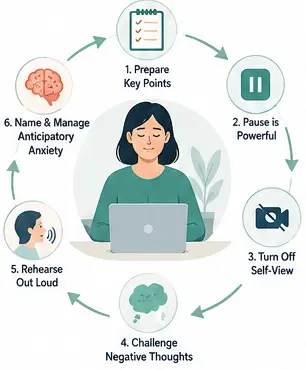
Minimize improvisation
Write down your update, jot down two or three key points, or simply create three bullet points before the meeting. Why? Because having a structure relieves the burden on an anxious mind. You won’t have to worry about “what to say next” during the meeting.
Reframe pauses as competence, not weakness
A two-second pause before responding can feel like everyone’s staring, but to the room, it usually reads as thoughtfulness “this person is giving a considered answer.” A pause signals competence more often than it signals uncertainty.
Turn off self-view on video calls
If possible, reduce the pressure associated with the camera. If the option is available, hide your own video feed. Watching yourself speak increases anxiety. Most people do not even realize this.
Challenge the “everyone’s watching me” assumption
Most people in a meeting are mentally preparing their own next contribution, not scrutinizing yours. You’re being watched far less closely than it feels like in the moment.
Rehearse out loud, not just in your head
You can record yourself, look at yourself in the mirror or say what you intend to say in a room by yourself. After you have physically said the words, you are not as likely to run into them when speaking live.
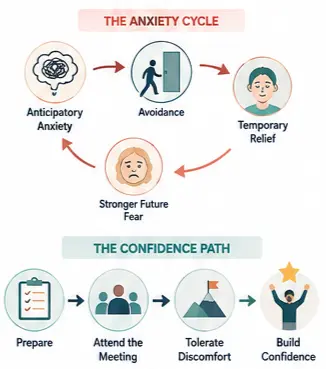
Recognize the cycle of fear.
The anxiety that sets in the night before a meeting. Do not ignore it; give it a name. Remind yourself: “My mind is rehearsing the worst-case scenario.” “This is not a prediction of what will happen tomorrow.”
Common Mistakes People Make
Avoiding meetings altogether. Briefly relieves the anxiety, but over time leads to a re-learning of the message that the meeting is indeed something to be feared.
Over-preparing to the point of exhaustion. Memorizing all the questions that could be asked can turn from a helpful to an anxious process. Plan sufficiently to make you feel secure, but not to remove all uncertainty.
Assuming everyone else looks calm because they feel calm. Given how common meeting anxiety actually is, the room is very likely far less composed internally than it appears.
Avoiding visibility opportunities altogether. Avoidance of opportunities to present and lead directly leads to avoidance of anxiety and can be a silent career cost over time.
Treating every meeting like a high-stakes one. Not all stands are created equal; if you prepare for the event, you’ll make sure that you don’t burn out on a leadership review.
When Not to Cope Alone
Look, feeling a bit nervous is normal. But if:
- You feel a sense of dread before facing even minor issues
- You are turning down a promotion or a new opportunity out of fear
- You are panicking, having a fast heart rate, shivering, or shortness of breath.
- Can’t sleep at night, and your mood is bad all day long.
In those instances, therapy through cognitive behavioral therapy (CBT) can be very helpful. It can be determined by discussing the situation with a therapist if this is a normal situation arising in the workplace, or if it is something that requires proper support. Do not forget, seeking help is not a measure of weakness; it’s a good decision.
Conclusion:
Last but not least, know this: anxiety prior to a meeting is not a bad sign; it is not a lack of preparation; it is not being “overly sensitive. In fact, your nervous system is doing what it would do, and it’s doing it the right way. You’re being monitored, evaluated, and questioned. Under such circumstances, everybody may experience a tightness in the chest. Once you know this, you’re not going to stop the anxiety, but one layer will be removed the layer of “anxiety about anxiety.” So, that’s a layer that you can shed right now.
Sources & Further Reading
Craft Docs (2023). "Zoomed In, Zoned Out" survey of 2,000 US remote and hybrid workers. Reported via People Management
Bailenson, J. N. (2021). "Nonverbal Overload: A Theoretical Argument for the Causes of Zoom Fatigue." Technology, Mind, and Behavior, Stanford University. Full text
Edmondson, A. C. (1999). "Psychological Safety and Learning Behavior in Work Teams." Administrative Science Quarterly, 44(2), 350–383. Full Text