
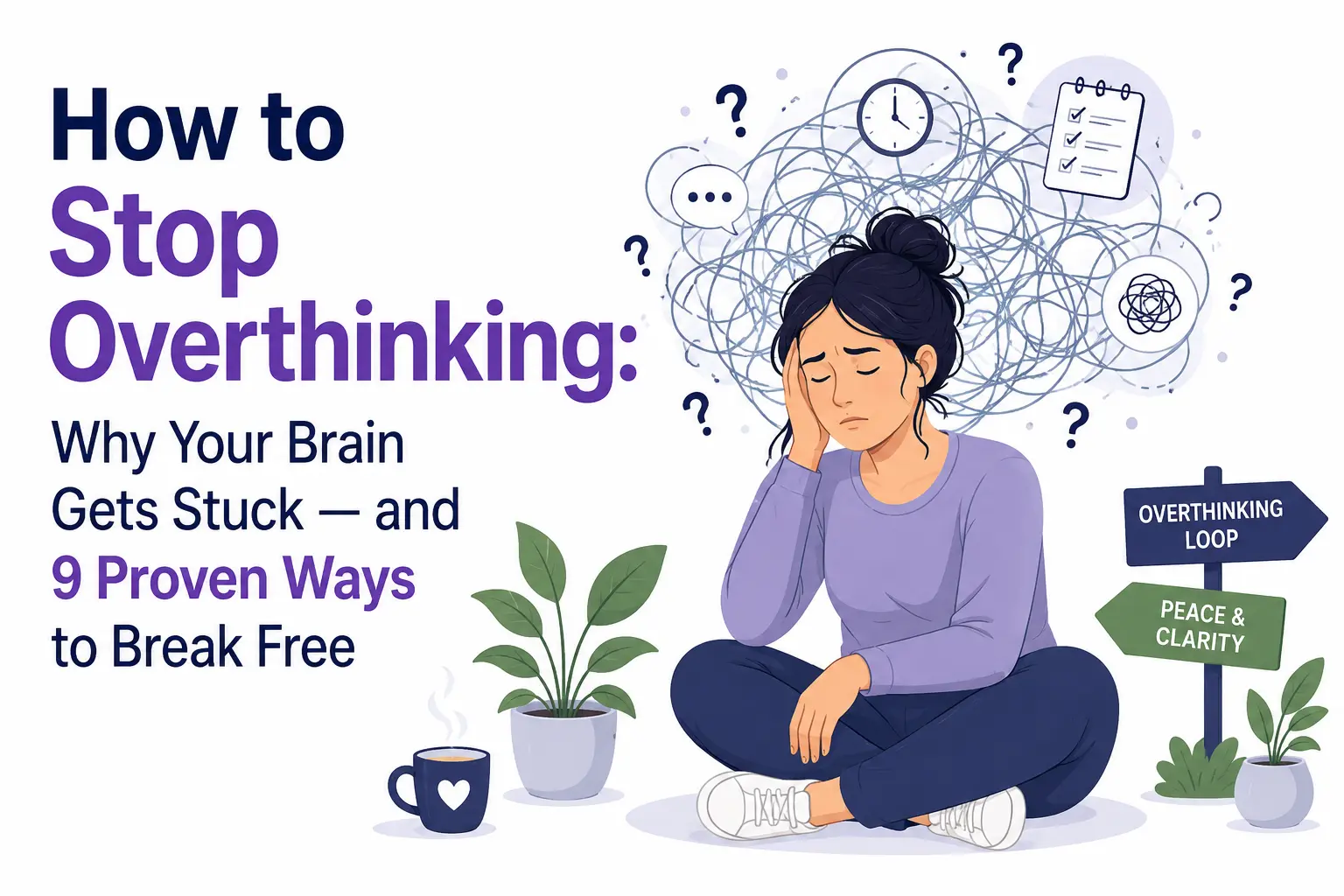
How to Stop Overthinking: Why Your Brain Gets Stuck and 9 Proven Ways to Break Free
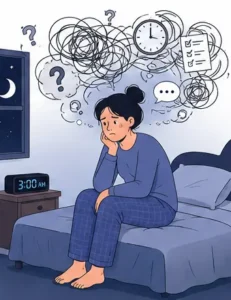
3 AM. Again, the same thought: The same “what if” and the same remorse. You have attempted to bring your efforts to a halt. You have turned off your phone, spoken to friends, and even taken sleeping pills. The loop is unconcerned. Here is what is actually happening and what genuinely works.
What is overthinking really? (This is not what many people think)
Many of us think that overthinking means that the person thinks too much and gets tense about everything. But this is not the real meaning of overthinking.
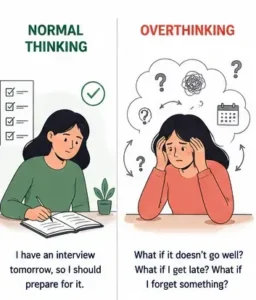
In psychology, overthinking refers to a thought not yielding a solution even after thinking about the issue repeatedly. The purpose of normal thinking is to find the solution to the issue, but the purpose of overthinking is just to keep thinking.
Normal thinking vs. overthinking: The 2 types of overthinking:
 The 2 types of overthinking:
Overthinking is not one thing. There are actually two types, and most people do have both, but typically one is more prominent. Knowing which type is to blame for your pattern can help you decide on your strategy.
Rumination stuck in the past: This is the sign where people always remain stuck in their past. I did that thing 3 years ago, people started thinking about me, I wish I had not made that mistake, it is such thoughts of the past that make a person overthink.
Worry living in a future that hasn’t happened: This is a sign where a person is preoccupied with something that hasn’t even happened yet the fear of what will happen tomorrow. What if I mess up tomorrow’s exam, what if I lose my job, what if my partner leaves me such thoughts, which have no existence in the present, also force a person to overthink.
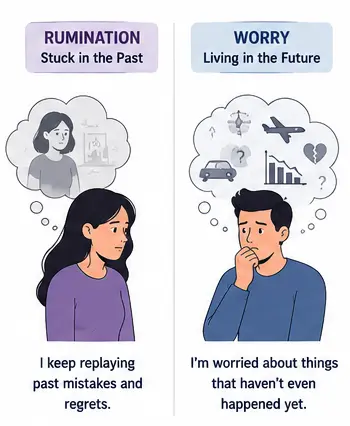
Ruminative overthinking is more common among women than men, and distracting oneself is more common among men than women, according to Dr. Susan Nolen-Hoeksema at Yale, the top researcher on rumination. Both approaches are effective, but over-thinking is much more likely to become clinical depression.
3 Signs You Are Overthinking, Not Just Thinking
Repetitive
In this, you repeat the same thing again and again, do not think of anything new, and no solution is found.Circular
The thought that comes to your mind, after wandering around, comes back to the same point from where it started, that is, you are not able to find any existence point of that thought.
Exhausting
After a normal thought, you get peace, and a solution is also found quickly, but after overthinking, you feel extremely tired and exhausted, as if you have lifted the weight of something heavy.
Why can’t I stop overthinking? The Psychology behind the loop
You have tried to stop. It has not worked. This is not a failure of willpower. There are specific neurological and psychological reasons why overthinking is so resistant to simply deciding to stop and understanding them is the first step toward actually addressing them.
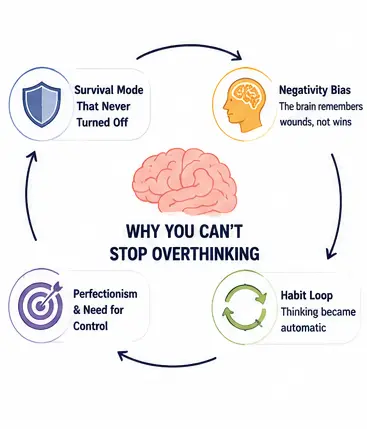
Survival mode that never got switched off
Let’s understand that a few years ago you had turned on a survival mode in your mind, that is, whenever you felt something was wrong, that alarm would on, but now years have passed since that, but you did not change your alarm, things changed, things changed, but you did not set that part of your mind which was on survival mode, and now it gets turned on for everything. Whenever you receive a message from your boss, you start feeling worried, even if it is not a threatening message; your mind has learned to survive in that mode, hence you still feel worried about everything, and you overthink because of it.
Negativity bias the brain remembers wounds, not wins
Our brain gets used to bad memories. Someone said 1 bad thing 5 years ago, and it is still remembered today. But someone praised you yesterday, and it is forgotten. The brain only remembers the wound, not the ointment.Habit loop thinking became automatic
Initially, you may find some solace in thinking, and you may feel that thinking brings you peace. But in reality, you get used to thinking, and a time comes when, even if you don’t want to think, your mind is running because of your habit. And because of this habit of yours, a loop of thinking is created that keeps going on.Perfectionism and the need for control
Our mind thinks that if we control our thoughts, most of our problems will be solved. But, it is not that easy. When we insist on being perfect in everything, the mind gets tired. And a tired mind starts overthinking.
The Hidden Damage Overthinking Does Over Time
You may not notice any effect of overthinking in the early days of your life. But after a few years, you will notice how deeply this habit has affected your life.
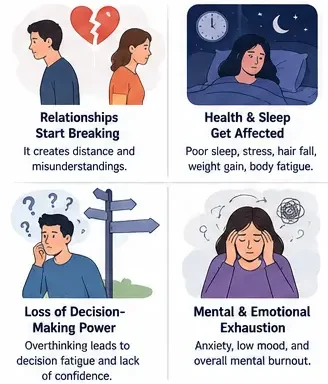
Relationships start breaking
Overthinking makes you distance yourself from others. When friends or family members say something, you take too long to think of a response. Then you think, “I was rude.” These misunderstandings ruin relationships.
Loss of decision-making power
Overthinking can cause you to struggle with decision-making. Decisions you previously made easily within minutes now become difficult. Overthinking tires your mind, leading to decision fatigue and a loss of courage.
Health and sleep are affected.
Overthinking affects your sleep. You spend the night exhausted by thinking about your past, which releases the hormone cortisol. As a result, your hair starts falling out, your weight starts increasing, and your body starts aching. Despite all this, your mind is still ruminating.
Opportunities are missed
Overthinking traps a person in “if, but, maybe.” When a good opportunity comes along, we waste it by overthinking. It’s just a pity that it’s left in the hands.
You become your own enemy
The biggest blow of overthinking is this – you start fighting with yourself. Old regret + low confidence = “I am a loser”. This disease makes you hollow from the inside.
Anxiety and depression develop
Mental health issues might result from overthinking. You could get depressed if you are always thinking about the past. Additionally, worry may arise if you are preoccupied with your future.
Related on Savvy Psyche
Research finding 47% of waking life
Some time ago, I studied a research. In it, people were asked what they were thinking right now. I was stunned to see the results. According to logic, we spend 47% of our time either in past mistakes or in fear of the future.
This means we spend half of our lives where we don’t even exist. Should I tell you the truth? This is absolutely true. When bread is in front of you, the mind is in the tension of tomorrow. When you sit with friends, you remember something from 5 years ago. When you lie down at night, all you want is “I wish my life would change too”. Our body is here, right now… but the mind? It neither comes out of the past nor the future. This is the reason why we are not able to live our present properly, and always remain in our past and future.
5 Major Mistakes You’re Making to Stop Overthinking
Force yourself to stop thinking.
The more you force yourself, the more you start thinking. This is called the white bear effect. This means that the more you stop something, the more it will come back.Thinking everything is 100% perfect.
Your mind wants to think everything is 100% perfect. But if a decision isn’t perfect, it forces you to wonder where you went wrong. So, make it a point to think that even 60% of the work is fine.Lying down at night and thinking about solutions.
When you lie down at night after being tired after the whole day, if you find solutions to your problems, then the problems will increase further, and no solution will be found.Fighting with yourself, not sharing anything.
We keep our opinions to ourselves always, for fear of being judged, which is a burden to us. Share your problems with someone you trust, and you will feel less burdened.To impose past mistakes on the future.
Overthinking arises from recalling or imagining past or future mistakes. If it has occurred in the past, then believing it will occur in the future. What you think now impacts your here and now.
9 Proven Steps to Actually Stop Overthinking
When you’re overthinking, most people advise you to stop overthinking and keep your mind busy. This is mostly valid advice. But we need practical solutions that help stop this problem. Those practical steps are:
5-4-3-2-1 grounding interrupt the loop immediately

When you feel the over thinking pattern starting, look at 5 things you can see, touch 4 things you can feel, listen to 3 things you can hear, smell 2 things, and taste 1 thing. Doing all this will bring your mind back to the present. It does not eliminate overthinking long-term, but it provides immediate relief and creates the mental space to use other strategies.Write it down externalize the loop
Whatever your mind is thinking, write it down on paper and ask yourself what it is that you’re worried about, and find a solution. Writing boosts your memory and helps you find a solution.Worry time, fix it
Decide on 15 minutes throughout your day to think. If you have an idea at 8 p.m., think until 8:15. Practice following that rule in your mind. It will be difficult at first, but as your mind accepts this rule, it will become accustomed to it, and it will only think for 15 min.Pay attention to what is under control
Make a list of what is within your control and what is not. Focus your energy only on the things that are within your control.Set a timer for 10 min.
Throughout the day, keep this in mind: you need to think about one thing for just 10 minutes. After 10 minutes, disconnect yourself from that thought. Drink some water, or distract yourself with some physical activity. Your mind needs to set boundaries and rules.Move your body
Make it a habit to do 30 minutes of physical exercise daily. When your body is tired, your mind won’t dare to think.Deep breathing
As soon as a bad feeling comes into your mind, sit in a comfortable place. Take a long, deep breath through your nose, pause for 5 seconds, then slowly exhale through your mouth. Do this step 5 times a day. While exhaling, think of any negative thoughts that are coming into your mind as being expelled. Deep breathing relaxes your mind, and you will feel better for some time.Keep your mobile phone away while sleeping at night
At night, there is a new thought of checking notifications on the mobile, which also disturbs sleep. Hence, one hour before going to sleep, put the phone on silent mode and keep it away from yourself.Write the worst situation and then find a solution
If a bad thought comes to your mind, write it down and think, what will I do if something as bad as this happens to me? If you get an answer to this, 50 percent of your fear will disappear.

When do you seek professional help?
If you’ve been struggling with overthinking for a long time and are finding it difficult to take these steps, you may want to seek help from a licensed therapist. A therapist will help you deal with this issue professionally and overcome it quickly.
Conclusion
Overthinking does not mean that you are weak or lonely; in fact, overthinking becomes a habit, and we do not realize when this habit tires us out and disturbs us mentally. If you recognize overthinking in its initial stages and tell yourself that you are overthinking and not thinking normally, a large part of the problem is already solved right there. Just do not think so much today that you are failing, everything may not be perfect, and whatever moment you are living, enjoy it fully. Whatever happened in the past is over; it will never happen again, and your future will be even more beautiful than the present. With this thought, keep yourself motivated and happy.
Reminder
Every thought that comes to your mind is not true. Don’t tire yourself so much that you forget the present. Live the time you have to the fullest and learn to be happy in everything, then see how beautiful life seems.
Disclaimer
All information provided in this article is based on mental health studies and personal experience. In this case, if you are experiencing a serious mental health problem, please consult a licensed therapist who has dealt with it professionally.
Sources & Further Reading
-
Nolen-Hoeksema, S. (2000). The role of rumination in depressive disorders and mixed anxiety/depressive symptoms. Journal of Abnormal Psychology, 109(3), 504–511. Psychology Today overview
-
Killingsworth, M.A., & Gilbert, D.T. (2010). A wandering mind is an unhappy mind. Science, 330(6006), 932. View study
-
Wegner, D.M., et al. (1987). Paradoxical effects of thought suppression. Journal of Personality and Social Psychology, 53(1), 5–13.
-
Borkovec, T.D., et al. (1983). Stimulus control applications to the treatment of worry. Behaviour Research and Therapy. (Basis for the scheduled worry time technique)
-
Pennebaker, J.W. (1997). Writing about emotional experiences as a therapeutic process. Psychological Science, 8(3), 162–166. View study
-
APA: Anxiety disorders and evidence-based treatments





2 Comments