
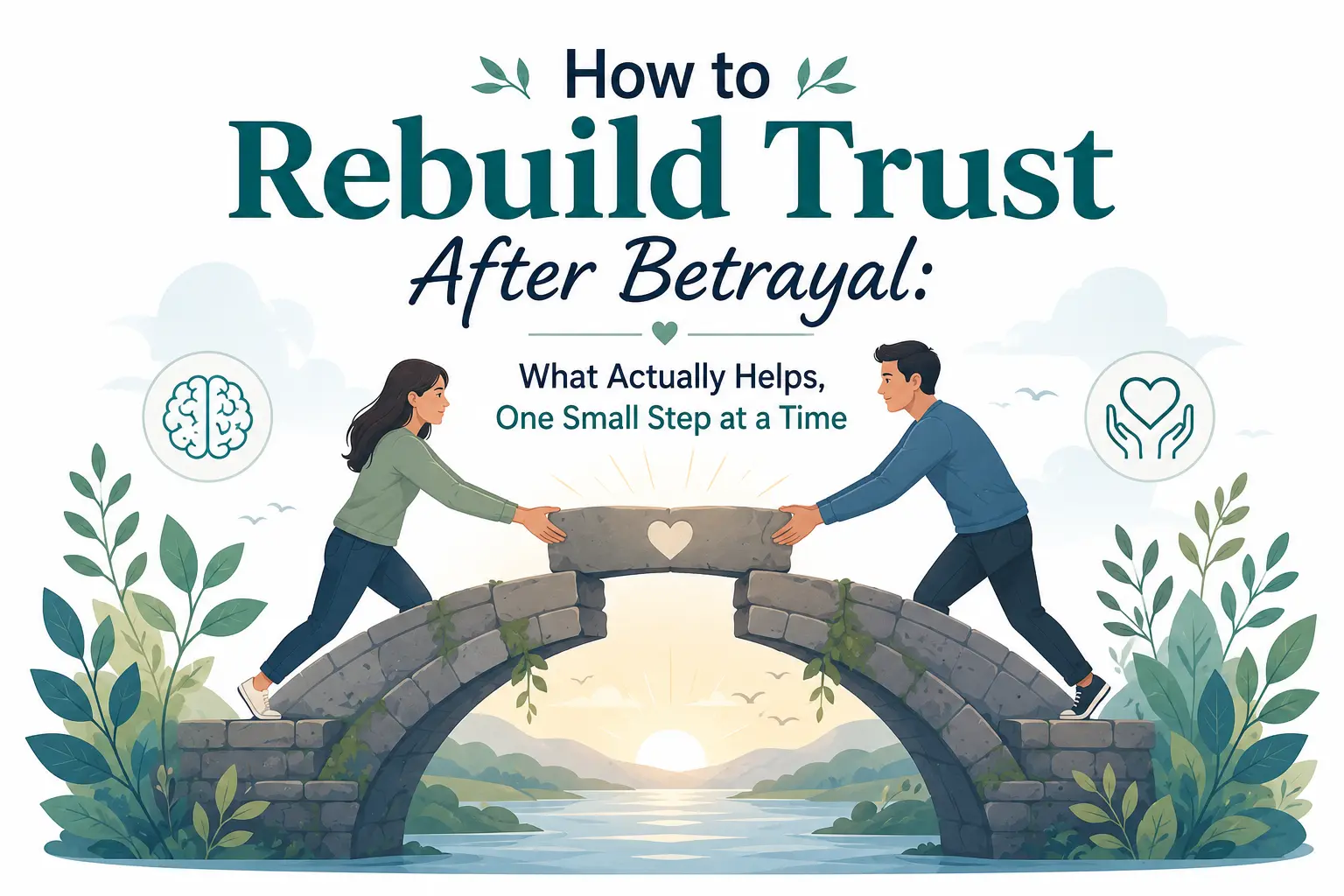
How to Rebuild Trust After Betrayal: What Actually Helps, One Small Step at a Time
How to rebuild trust after betrayal is one of the hardest emotional challenges a person can face. An apology was offered. Life hasn’t moved forward. Everything outside looks the same, but everything inside feels different. If you’re in this in-between place, here’s why it’s so hard and what genuinely helps rebuild what broke.

Why Rebuilding Trust Isn’t Easy
Understanding this makes the rest of the process easier to bear. Betrayal by someone close isn’t like an ordinary disagreement. Research on the neuroscience of social pain has found that experiences like rejection and broken trust activate some of the same brain regions involved in processing physical pain, particularly the anterior cingulate cortex. “It hurts” isn’t just a figure of speech here the body genuinely registers the ache of trusting someone who let you down.
That’s part of why “just forget it” doesn’t work, no matter how much both people want it to. Trust isn’t a single event it behaves more like a habit, rebuilt gradually through small, repeated proof over time. One sincere conversation, however heartfelt, won’t undo it on its own.
There’s a second, less-discussed wound: when trust breaks, we don’t just question the other person we question ourselves. How did I miss this? Was I too naive? Often, the self-blame runs even deeper than the anger at the betrayal itself. Repairing the relationship also means addressing this quieter, more private wound.
If You Are the One Who Was Hurt
If you’re wondering how to rebuild trust after someone has hurt you, the first step is understanding your own emotional response. This part is very important, and often gets ignored: Mending the relationship isn’t solely their responsibility. You have to play your part, too. Yes, I know the fault wasn’t yours. But it takes effort from both sides to make things work.

Forgive yourself first
Not for you but you: why couldn’t I understand? Mindset the one that continues to haunt you after the hurt has passed.
Recognize vigilance, not weakness
Inquiring too much, seeking constant reassurance, having doubts. These aren’t flaws. They are the part of you saying, “I won’t get deceived again.” These are not habits born of a need for control. They are the nervous system’s way of protecting itself from further pain. When we understand this instead of judging it, this behavior begins to subside on its own.
Don’t rush your own timeline
The one who inflicted the wound has no right to set the timeline. Forget it, move on no. Trust will return at the pace of the heart that was broken, not the one that broke it.
How to Rebuild Trust in Yourself After Betrayal
Betrayal doesn’t just damage trust in another person it shakes trust in your own judgment, instincts, and ability to read people. You might notice unease meeting both strangers and old friends, or a nagging sense that you “can’t make sense of anything,” even when part of you clearly can.

Rebuilding self-trust runs on a different track than rebuilding trust in a partner, and takes its own kind of patience:
Separate the voice of fear from the voice of your heart.
Not all anxiety is a warning. The anxiety can sometimes just be a result of being hurt earlier. So, take a step back and say to yourself, what do I really have? Rather than asking “What am I thinking?
Track small kept promises to yourself.
I made a promise to myself and kept it. No matter how trivial it might seem. Like, I said I would handle this matter patiently, and I did. It serves as a reminder that your word matters. Even without anyone else involved.
Don’t let one betrayal define every new situation.
What happened has sharpened your understanding, and that is a good thing. However, that does not mean you should view every new person with the same suspicion that the previous one earned.
It takes more time to trust oneself than it does to trust others. This is due to the fact that you are the one who must apply the healing balm because you were the one who was injured. No other witness is present. As a result, treat yourself with the same patience that you would like others to have.
Related on Savvy Psyche
Why Do I Get Attached So Easily? Causes, Signs & How to Stop Emotional Attachment
11 Signs of an Emotionally Unavailable Partner (And What Actually Helps)
If You Caused the Betrayal

Acknowledge your error, but do not explain the reasons.
I am sorry, and I know that this made you feel bad. This is a heart-wrenching sentence! But when “but you also” comes in, all is lost. Do not add a “but” to an apology, or it is no longer an apology.
Hearing without taking offense. It’s the most difficult part.
They may repeat the same wound many times, each time in a slightly different way. The pain doesn’t run away until it is spoken. So, at that time what you want to do is NOT argue! Your job is to listen with your heart.
Don’t make promises; prove it.
It is easy to say, I will change everything. But a relationship isn’t built on grand statements. It is built on the small things you do every day. Following through on what you said consistently. Without needing to be coaxed. Trust isn’t built on slogans. Trust is built on your patterns of behavior.Give time to the healing process it is something you cannot rush.
You might feel, I’m fine now; let’s move on, yet the wounds may still be there. This doesn’t mean you have failed; it simply means that both sustaining an injury and healing from it take time.
How to Rebuild Trust Together
Trust researchers John and Julie Gottman describe repair after betrayal as a three-phase process Atone, Attune, and Attach moving from acknowledging the harm, to rebuilding emotional connection, to gradually restoring intimacy and security. In practice, that looks like:

These psychology-backed strategies show how to rebuild trust one small step at a time.
Name the commitment out loud
It might sound very ordinary. But when everything starts to feel difficult, this is the one sentence you both will hold onto as you move forward.
Agree on what happens next
Saying the words “I will change” is simple, but it is hard to actually do it. Rather, state: “If X occurs again, I will not be able to keep it to myself anymore, and I will tell you right away. If the situation is clear, both partners are aware of whether or not the relationship is going well.
Let the same question be asked again
Do not say, “Why are you asking this again?” Sometimes, the heart needs to hear the same thing repeatedly before it finds peace. Repeating a question is not a sign of weakness; it is part of the healing process.
Start small, not big
Start by sending messages on time. Follow through on the things you promised to do. Only when trust is restored in these small matters will the relationship begin to feel “normal” again.
Check in honestly, without fixating on “that day”
Now and then, sit down and ask: Hey, is our relationship getting better? Honestly. Without fear. Because healing comes not just from forgetting the incident, but from moving the relationship forward.
Signs That Trust Is Being Rebuilt
The truth is, a relationship doesn’t just fall into place all at once; there is no grand scene or cinematic moment. Progress happens quietly. So, instead of waiting for the moment when “everything will be perfect,” look for these small signs:
- Now, the doubt is subsiding on its own. Earlier, I felt the urge to check my phone every five minutes. That craving has diminished now. You aren’t forcing yourself to stop; it’s just that your heart no longer feels that same restlessness.
- Now, happiness isn’t mixed with fear. In the past, a lingering dread accompanied every good day the fear that it might all fall apart again. Now, you can laugh and eat without tension. Your mind doesn’t wonder, Is there something wrong with this? With every bite. You are simply living.
- Now, we don’t reopen old wounds over every little thing. In the past, even a comment like “You put too much salt in this” would end with “And you did *that* back then, too.” When an old incident doesn’t come up during an argument about the dishes, know that the wound is healing.
- “Are you with me?” You no longer have to ask this every day. If my heart feels uneasy, I might ask once. But that restlessness which used to arrive every morning as a question is gone now. This is the difference that healing brings.
- You no longer fear opening the door to your heart just a little. I’m tired today. I’m worried about this. Shall we plan this? You don’t have to lie awake all night regretting having shared these little things. When this happens, know that trust has returned. It is no longer just a matter of “making do.
Don’t rush. Everything won’t be fixed all at once. There is no deadline, nor is there a trophy. Healing comes the way a broken glass is mended piece by piece. There won’t be a single day when you say, That’s it, everything is fine from today on.” Your heart will simply grow lighter, little by little.
A Real Pattern From Practice
The issue was that Danish had lied about money. But Reema wasn’t upset about the money itself. What she said was: “I’m afraid what else is being hidden?” And that is the deepest wound of all, isn’t it? When one lie is uncovered, it casts doubt on the entire relationship. “What else wasn’t true?”
Trust wasn’t restored through apologies. It returned through three months of quiet, consistent effort. Danish began voluntarily showing the receipts and messages things no one was even asking for anymore without any need for grand gestures. And Reema learned to distinguish between checking out of fear and checking out of anger; instead of hiding that difference, she began to voice it. A single meeting didn’t change anything. The relationship shifted the twentieth time he kept his word without drama, just on an ordinary day.
How Long Does This Actually Take?
There is no single correct answer to this. Anyone who gives you a specific number of weeks is simply guessing. However, certain factors do influence the timeline:

|
|
|---|---|
|
|
|
|
|
|
Most people notice a real difference within three months to a year. Deeper wounds can take longer. And healing rarely moves in a straight line a hard day doesn’t mean you’ve failed. It just means you’re human.
When Rebuilding Trust Isn’t the Right Path
Sometimes learning how to rebuild trust also means recognizing when trust can no longer be safely restored. Not every broken relationship can be mended. However, it is not always a suitable option to mend a broken relationship. If it is more of a pattern, and if the person regularly tries to trick you, massage the truth, or if the person is just a plain old manipulator who will never change, then you can’t trust that person again. No matter what you try, you’ll never get it done. In times like that, it’s not “How do we fix this? In those times, it’s not “How do we fix this? So, the questions are, what is the truth and what’s my decision going to be? When making that decision, it is important to get the assistance of somebody else.
When to Seek Professional Help
Consider consulting a couples therapist or an individual therapist if:
- The past keeps resurfacing. Months have passed, yet the wound remains just as raw.
- Your heart says, “Forgive and move on,” yet it refuses to accept that.
- You have lost your sleep, your anxiety has mounted, or you have begun to feel less worthy.
- Deep down, you suspect that this wasn’t just an oversight it is a habit.
A therapist’s work is not magic. Their role is to give both parties the time actually required, neither rushing things nor holding back out of fear. And most importantly: They can hold up a mirror to show whether the wound is healing or if you are simply bandaging the same spot over and over again.
Conclusion:
A single apology couldn’t fix everything. Nor was it meant to. Healing happens in the little things. Keeping the same promise for the twentieth time, and choosing to keep your heart open just a little bit each day, instead of shutting it tight. It won’t feel easy. But it won’t be fake. And what is real always takes time.

If You Are in Crisis
SavvyPsyche is an educational website, not a crisis service, and nothing here can help in an emergency. If you are in immediate danger or feel you may act on thoughts of harming yourself, please contact emergency services in your country right now (911 in the US, 999 in the UK, 112 in most of Europe).
You can also reach a trained crisis counsellor, free and at any time:
- United States: Call or text 988 — Suicide and Crisis Lifeline (988lifeline.org)
- United States: Text HOME to 741741 — Crisis Text Line
- United Kingdom & Ireland: Call Samaritans on 116 123 (free, 24/7), or visit samaritans.org
- International: Find your country’s helpline at findahelpline.org or iasp.info/crisis-centres-helplines
- If a partner or family member is frightening or controlling you: call the National Domestic Violence Hotline (US) on 1-800-799-7233 or visit thehotline.org
Reaching out is not a burden on anyone. It is exactly what these services exist for.
Disclaimer:
All the information provided in Savvy Psyche’s articles is based on personal experience, exposure, and the study of mental health; if you are facing a serious mental health issue, please consult a licensed therapist.
Sources & Further Reading
-
"Rebuilding Trust After an Affair: The Gottman Method Approach." Vox Mental Health, summarizing the Atone-Attune-Attach framework by Drs. John and Julie Gottman. vox mentalhealth.com/blogs/rebuilding-trust-after-an-affair-the-gottman-method-approach
-
Eisenberger, N. I. "The Pain of Social Disconnection: Examining the Shared Neural Underpinnings of Physical and Social Pain." Nature Reviews Neuroscience (2012). nature.com/articles/nrn3231
-
"Betrayal Trauma." Wikipedia, summarizing Jennifer J. Freyd's betrayal trauma theory. en.wikipedia.org/wiki/Betrayal_trauma
-
Bernstein, R. E., Delker, B. C., Knight, J. A., & Freyd, J. J. "Hypervigilance in College Students: Associations with Betrayal and Dissociation." PubMed. pubmed.ncbi.nlm.nih.gov/26121174


One Comment