
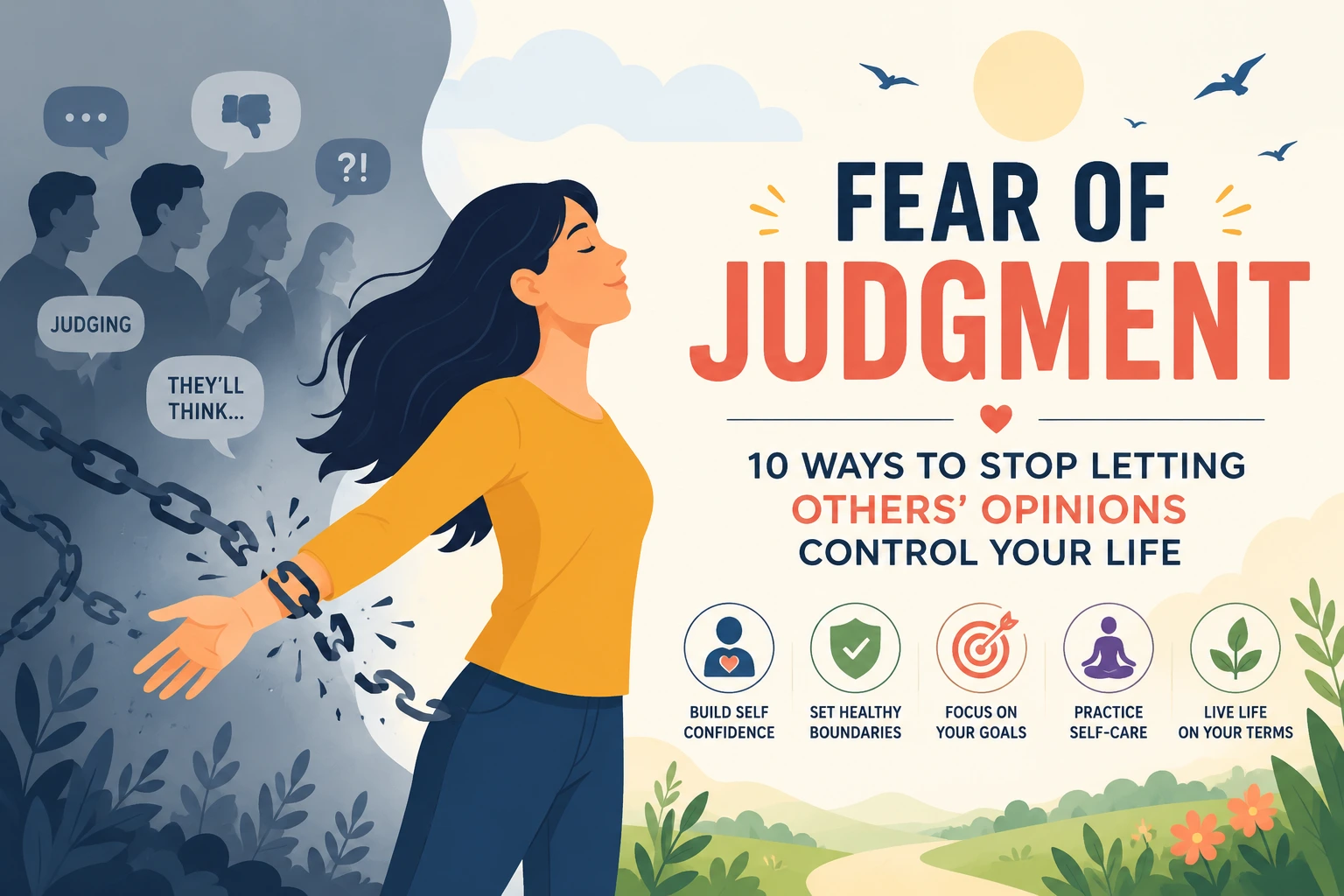
Fear of Judgment: 10 Ways to Stop Letting Others’ Opinions Control Your Life
You’ve probably done this before: taken a photo you genuinely liked, started to post it, then deleted it seconds later, not because you disliked the photo, but because you were more worried about how someone else might judge it than about your own enjoyment of it.
If fear of what people will say has quietly steered decisions you actually cared about, this article walks through what’s really happening, where that fear comes from, and a clear, practical way to loosen its grip.
What Is Fear of Judgment?
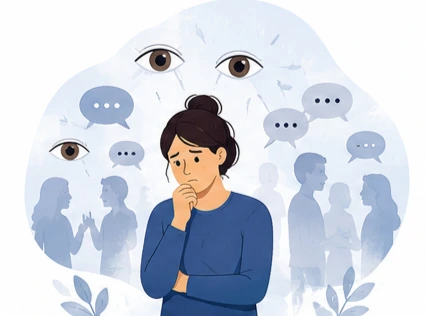
Fear of judgment is a fear that comes from constantly thinking about what other people think and say about your appearance and behavior. This thought constantly comes to mind, especially when you’re socializing. You are very afraid of saying something wrong that will embarrass you.
In the past, if a tribe cast someone out, survival was difficult. That is why “fitting in” was a matter of survival. Today, our lives are not at risk. Yet, our brains are still running that same old software. They perceive a threat if someone speaks ill of us; that is why we are so afraid.
Why Does This Fear Feel So Powerful?

Because our internal programming is ancient. The brain knows that saying the wrong thing in a meeting won’t get you banned. But the body’s system is still stuck in an old mode; it interprets social disapproval as an immediate “threat.” The fear of “what people will say” keeps us rooted in one place. We cannot truly be ourselves. It is a cage, and as long as you remain confined within it, your life will continue to revolve within that same narrow circle.
What Psychology Says About Fear of Judgment
Psychologically, fear of judgment often creates a running assumption that other people are evaluating or criticizing you in social situations, whether or not that’s actually happening. Researchers Mark Leary and Robin Kowalski, known for their self-presentation theory of social anxiety, found that social anxiety tends to arise specifically when someone is motivated to make a good impression but doubts they’ll be able to pull it off. In other words, the fear isn’t really about other people’s cruelty it’s about the gap between wanting to be seen well and not trusting that you will be.
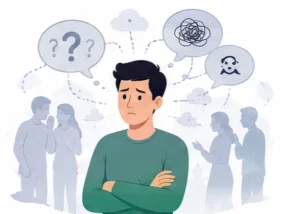
The Thought Patterns Behind It
“Everyone is looking at me”
The felt sense that all eyes are on you rarely matches reality most people are far more absorbed in their own self-presentation concerns than in cataloguing your small missteps. Often, the harshest imagined critic is simply your own inner voice.The imaginary audience
It’s easy to feel like you’re performing for a constant audience, when in reality most people are preoccupied with their own perceived audience meaning your small error or unconventional choice usually registers far less than it feels like it will in the moment.Treating others’ opinions as an alarm bell
People are usually less harsh than the fear predicts and sometimes judge you for something that never even crossed your mind. Since you genuinely cannot control what others think no matter how hard you try, there’s real relief available in simply accepting that and redirecting the energy elsewhere.
Where Fear of Judgment Comes From
Fear of judgment doesn’t develop suddenly. It develops due to certain psychological and social reasons.
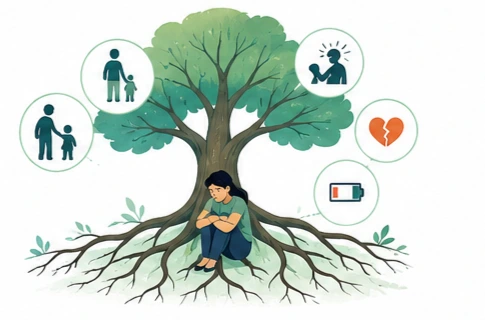
Strict or conditional parenting: In strict parenting, this thing is instilled in the mind of the child from childhood that he has to achieve good grades and positions and always bring medals, otherwise he will be punished. A child experiences this as a child, and even after growing up, he is afraid of making mistakes.
Fear of rejection: Fear of judgment actually comes from the fear of rejection. People always try to make others happy, but they should not make any mistakes, due to which they have to face rejection.
Past trauma: Fear of judgment also develops from past traumas. These traumas include rejection, bullying, and criticism.
Low-self esteem: When you trust others more than you trust yourself, your own opinions don’t matter.
Signs You Have a Fear of Judgment
- Avoiding social gatherings
- Always perfectionism
- Overthinking
- People-pleasing
- Fear of public speaking
- Repeat things over and over again
- Avoiding group discussions
- Difficulty speaking NO.
- Stay silent even when you’re uncomfortable
- Feels good when alone
- Problems in decision-making
- Fear of asking questions in public
- Whatever you wear, you feel uncomfortable
- Thinks a thousand times before speaking.
- Hesitate to try new things
Fear of judgment’s impact on life:
- Fear of judgment makes it difficult to achieve your goals.
- It creates distance in your relationships.
- You miss different opportunities in your life.
- You are afraid of socializing, which leads to social anxiety.
- You destroy your self-worth by getting caught up in the fear and judgment of others.
- Your opinions and your own choices do not matter to you, due to which you become a victim of low self-esteem.
- Always agreeing to other people’s decisions impairs your own decision-making.
- Fear of judgment kills your personal growth. You start thinking a thousand times before you act. This leads to overthinking and makes you avoid taking risks in your life.
- Fear of judgment erodes your confidence. You lose your identity.
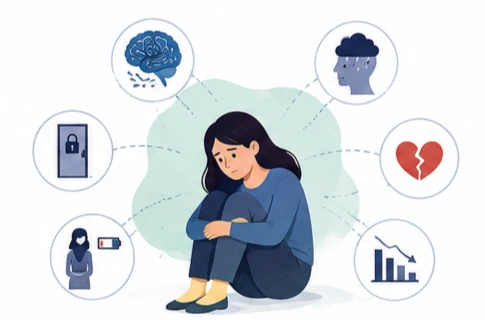
Fear of judgment impacts on mental health:
Fear of judgment has a profound impact on your mental health.
Social anxiety: The fear of being judged can make you un-socialize. Your fear of judgment can lead you to social anxiety, and you may start avoiding social gatherings, meetings, and group discussions.
Constant overthinking: Constantly thinking about others’ opinions, advice, likes, and dislikes. Thinking about them all the time may give you the habit of overthinking.
Depression: separating yourself and avoiding social gatherings for a long time can lead you to sadness, hopelessness, and depression.
Suppressed emotional feelings: Hiding your true feelings and emotions for fear of being judged can lead you to an inner disturbance.
Avoidance behavior: Avoiding social situations all the time can lead you to avoidance behavior, which can lead to loneliness.
When worry about failing drives this avoidance, it is closely tied to fear of failure.
Fear of judgment in adults:
Fear of judgment is a very common issue nowadays. When a person reaches adulthood, they met a new peoples and socialize more, but if they have the same fear of judgment at that age, they can be unfavorably impacted mentally, even at that age. In adulthood, most people are very sensitive about their appearance. That is the age when you get groomed, but some people are not confident about their body and appearance at that age, and are always afraid of body shaming.
At this age of a person, if someone passes negative comments related to body shaming, then some people take it very seriously and thinks negative about themselves, which becomes their fear, but that fear develops into their personality in the form of judgment.
The Real Story: The Person Whose World Kept Shrinking Year After Year
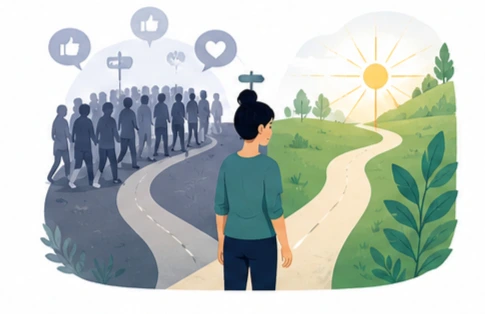
At 29, Nadia realized that nearly every major decision she’d made in the past decade had been driven by one question: what will people say? She’d studied business because it was her family’s wish, not hers. She’d stayed in a relationship two years longer than she wanted to, because ending it would mean explaining herself to everyone. She’d written privately for three years, terrified of how people she knew might react if they read it.
“I wasn’t afraid of the world,” she said. “I was afraid of twelve specific people. I’d already scripted what they’d say.” Then, on her birthday, someone asked her a simple question: “what do you love?” She didn’t have a real answer, and it hit her hard. “I realized I’d been hiding myself so no one could judge me but I’d forgotten that being real in front of people matters too. I wonder if I was protecting myself, or slowly burying myself.”
A week later, she published her first blog post publicly. The reaction was nothing like the catastrophe she’d imagined a couple of heartfelt comments from strangers, a few people she knew saying they had no idea she wrote. But the real shift, she says, wasn’t the praise: “posting it felt like finally speaking the truth out loud in the room. Even if no one had read it, it still would have mattered.”
Since then, she’s changed jobs and ended the relationship she’d been holding onto. “The fear is still there,” she says. “The difference is, it doesn’t make the final call anymore.”
How to Overcome Fear of Judgment

Use your body, not just your mindset
Daily 15 to 30 mins exercise and deep breathing All the “what will they think” that is going around is manifested physically through stressed shoulders, shallow breathing, and high levels of stress hormones. Endorphins and serotonin allow for movement (walking, yoga, sport, cycling) to truly release anxiety with the benefits present within the body 15 to 30 minutes of movement per day. The breathing technique is quite basic: In for 4, hold for 4, out for 6, and over time, social situations feel less threatening as you practice the technique on a regular basis..
Build identity through self-reflection, not comparison
Stop comparing yourself to others. Accept and build your own identity. Comparing yourself to others’ highlight reels reliably increases anxiety and lowers self-worth. Ask yourself directly: what do I actually like? What are my core values? Who do I want to become? Answering honestly, even if it feels hard at first, builds an identity sturdy enough that comparison stops having much power over it.
Expose yourself to small social risks on purpose
Take small steps to socialize. Indulge yourself in group discussions, meetings, and parties. By avoiding situations, you will get temporary relief but your brain will learn that these situations were in fact dangerous, which will make them more fearful. Small, frequent exposure is more effective: Talk up once in a meeting, go to an event for an hour, introduce yourself to a new person. Every passing moment is real proof that everything was fine no proof can be gathered without avoiding it.
Use affirmations consistently, not just when panicked
Always be positive and think positively about yourself. Practiced only in moments of crisis, affirmations don’t do much. Practiced daily ideally each morning, and again a few minutes before a triggering moment like a meeting or a post statements like “what I have to say matters” or “I’m okay as I am” gradually shift the internal narrative your fear has been running.
Act confident before you feel it
Your confidence is the key to your success. So, stay confident in every social situation. Confidence isn’t arrogance it’s just being, hands down, one of the people who doesn’t let one interaction dictate your value. No need to feel it first, but repeated regular acting will eventually lead to feeling it.
Practice real self-care, not self-image management
Always love yourself, no matter what the comment is, good or bad, you should take care of yourself. Wear what you like and what you are comfortable in. This is important for both your mental and physical health·
Set boundaries and notice what actually happens
You only need to think about what is happening in your life. What others will think or say is not your concern; you just enjoy your life freely. Every time you say no and nothing catastrophic follows, you gather direct evidence that your voice matters and your needs are allowed. This kind of proof is one of the most effective antidotes to the fear itself.
Write your emotions down instead of suppressing them
The suppressed emotions do not go away they tend to come out as headaches, irritability or a general sense of weightiness, and then everything new in social interaction seems more threatening. It’s the same feeling, but you’re not writing for anyone else, and you’re not taking the filter, there is no filter.Limit social media and reclaim your own perspective
Curated online lives aren’t a fair comparison point. Small changes checking social media only twice a day, avoiding your phone for the first hour after waking and the last hour before sleep measurably shift the internal question from “how do I look” to “how do I actually feel.”
Choose a small circle of genuinely positive people
A few people who know and accept the real you do more for this fear than a wide circle of acquaintances ever will. Being genuinely known and still accepted is one of the most direct counters to the fear of judgment that exists.
When to Seek Professional Help
Judgment is a natural part of humanity. If this fear is causing you to avoid social situations completely, causing significant distress throughout the day or if it feels like you have social anxiety disorder (SAD) an ongoing, intense fear of social situations that impacts your work, relationships or daily life it’s worth talking to a licensed therapist. This is very common, and can be treated.
Reminder:
What is happening in your life? What do you do? Others are not interested. It is only your fear that is disturbing you mentally and physically. Live your life as per your wish and happiness, do not waste it worrying about others. So, get control over this fear of yours and live happily with your loved ones in your life without any fear.
If You Are in Crisis
SavvyPsyche is an educational website, not a crisis service, and nothing here can help in an emergency. If you are in immediate danger or feel you may act on thoughts of harming yourself, please contact emergency services in your country right now (911 in the US, 999 in the UK, 112 in most of Europe).
You can also reach a trained crisis counsellor, free and at any time:
- United States: Call or text 988 — Suicide and Crisis Lifeline (988lifeline.org)
- United States: Text HOME to 741741 — Crisis Text Line
- United Kingdom & Ireland: Call Samaritans on 116 123 (free, 24/7), or visit samaritans.org
- International: Find your country’s helpline at findahelpline.org or iasp.info/crisis-centres-helplines
Reaching out is not a burden on anyone. It is exactly what these services exist for.
Disclaimer:
This article is for informational purposes only. This is not advice from a doctor or therapist. If you are experiencing significant emotional distress, please speak to a licensed psychologist.
Sources & Further Reading
-
Leary, M. R., & Kowalski, R. M. (1995). Social Anxiety. Guilford Press; see also Leary, M. R., & Kowalski, R. M. (1990). "Impression Management: A Literature Review and Two-Component Model." Psychological Bulletin, 107(1), 34–47. Full text via ResearchGate



8 Comments